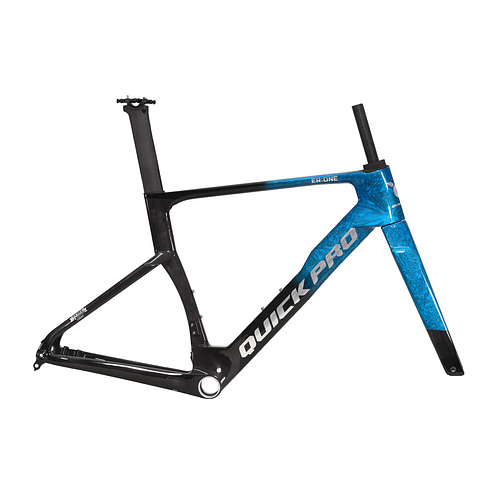
QUICK PRO ER:ONE
FrameThe Quick Pro ER:ONE is an aero road frameset with a T47 bottom bracket, UDH and an integrated cockpit, sold direct for about $2,400 (frameset) and through dealers in several regions. Owners like its stable, smooth ride, including in crosswinds on deep wheels, and a frame weight of about 1,000 g in size M, roughly 150 g under comparable Western aero frames. Official tyre clearance is 30-32 mm, but one owner fits a 34 mm (measured) tyre with about 5 mm to the chainstays. Any standard UDH direct-mount hanger works for a Shimano direct-mount rear derailleur; Quick Pro is said to supply one, but not every owner got it. The stock integrated bar is low, so some use a riser bar or a conventional stem and bar. Weak points are low resale value, bigger bottles rubbing the down tube, the occasional paint flaw and one fork whose carbon thru-axle threads bound and started to delaminate. Owners comparing it with the XMCS VRT find the two very similar.
AI Summary
Pros
- Good value: frameset around $2,400 and complete Dura-Ace bikes around $5,700, well below Western aero bikes with similar features.
- Stable, smooth ride that stays composed in crosswinds with deep-section wheels and is responsive on climbs and descents.
- Modern standards: UDH, T47 bottom bracket and an aero shape with CFD work behind it.
more pros in the review
Cons
- Low resale value and little brand recognition compared with established Western brands.
- Large bottles can rub the down tube; owners use smaller bottles, protective tape or a Giant Propel aero cage.
- The rear derailleur sits very close to the chainstay on the smallest (10T) cog and needs careful adjustment.
more cons in the review
Key Points
- Frame about 999-1,000 g in size M (raw), fork about 480 g; paint adds weight.
- T47 bottom bracket; Bikone and Novaride are popular replacements.
- UDH; any standard UDH direct-mount hanger works with Shimano direct-mount derailleurs.
more key points in the review

iGPSPORT BiNavi Air
Bike-ComputersThe iGPSPORT BiNavi Air is a smaller, cheaper version of the BiNavi bike computer: about $196 against $288 for the BiNavi, with a 1,020 mAh battery rated for about 30 hours. It runs the same firmware family with OSM-based maps, GPX navigation, custom and TrainingPeaks workouts, live tracking and radar support, including Garmin radars. Owners call it excellent value and a big step up from basic units. One prefers its climb feature to a Garmin 530's ClimbPro and has seen none of the 'sticky watts' reported on other iGPSPORT units. Common gripes: - the screen is darker and less vivid than rivals, though readable in sun; - iClimb only works when following a loaded route; - no Strava Live Segments or direct Strava upload from the unit; - altitude auto-calibration has been unreliable; - map updates work only on Windows; - iGPSPORT's lineup is confusing, with different screens and iClimb levels per model. The BiNavi Ultra (399 EUR, October 2026) adds free-ride iClimb, Strava Live Segments and a 3.7" screen; owners hope some of this reaches the Air by firmware.
AI Summary
Pros
- Very good value: about $196, roughly $90 less than the BiNavi, and a big upgrade over basic computers.
- Climb feature on a loaded route works better than ClimbPro on a Garmin 530 for one owner.
- Slim design with a compact screen that some prefer to tablet-like units.
more pros in the review
Cons
- The screen is darker and less vivid than rivals; others find it adequate even in direct sun.
- iClimb only works when following a preloaded route, unlike the newer BiNavi Ultra.
- No Strava Live Segments and no direct Strava upload from the unit.
more cons in the review
Key Points
- Price about $196 (BiNavi about $288; BiNavi about £169 on Amazon UK).
- Battery 1,020 mAh, about 30 h; BiNavi 1,250 mAh / 35 h; iGS800 2,050 mAh / 40-55 h.
- OSM-based maps optimised by iGPSPORT; map updates via Windows only.
more key points in the review
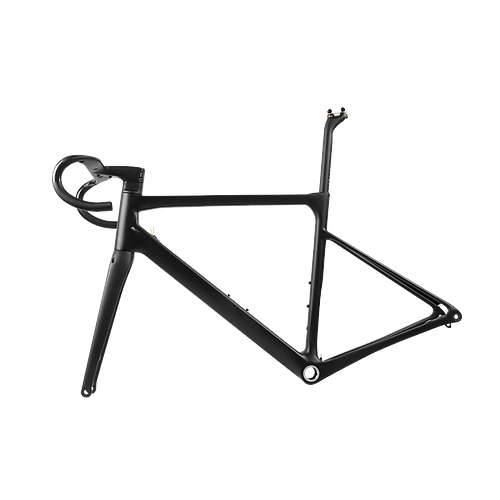
Carbonda CFR-1056
FrameThe Carbonda CFR-1056 is an endurance road frame, often compared to the Giant Defy and Canyon Endurace. It is designed for comfort on long rides with a relaxed geometry, internal or semi-internal cable routing options, and a focus on tire clearance. The frame is made from carbon fiber, with users reporting frame weights around 1050-1250g depending on size and paint. It uses a BB86 press-fit or BSA threaded bottom bracket (BSA became available later). The fork weight is around 480-520g. Pricing for the frameset (frame, fork, seatpost, clamp) starts around $490 USD for external routing and $650 USD for internal routing with an integrated handlebar, plus shipping and paint costs. Users highlight its value, good paint quality, and versatility for endurance riding and light gravel.
AI Summary
Pros
- Good value for money compared to branded frames
- Comfortable endurance geometry suitable for long rides
- Wider tire clearance than specified; fits up to 35-38mm tires
more pros in the review
Cons
- Some quality control issues: misaligned rear brake mounts, uneven paint on mounts
- Headset (especially Carbonda's) can be problematic; FSA ACR recommended
- Front derailleur cable routing through BB guide is tight and difficult
more cons in the review
Key Points
- Endurance road geometry similar to Giant Defy/Canyon Endurace
- Carbon frame, weight ~1050-1250g, fork ~480-520g
- Tire clearance: official 32mm, but fits 35-38mm in practice
more key points in the review
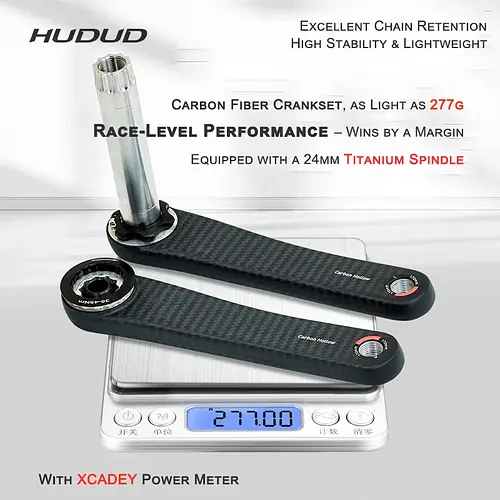
HUDUD Carbon Road Bike Crankset
CrankThe Hudud Carbon Road Bike Crankset is a lightweight carbon crankset available in various lengths (e.g., 160mm, 165mm, 167.5mm) with 110x4 spider configuration. Users report a listed weight of 309g +/-10g but actual measured weight was 318g; the 167.5mm version with all hardware weighs 308g, while the 165mm arms and spindle weigh 180g. The spindle features innovative weight reduction design with a larger bore diameter between threaded ends. The carbon finish is described as nice satin with visible weave and simple branding. However, significant compatibility issues exist with Shimano chainrings, particularly with the spider diameter being incorrect (95-96mm vs Shimano's 94mm), preventing proper fitment of DA chainrings. The vendor has been unresponsive in resolving this issue over several weeks, and some users have returned the crankset due to the defective spider. Additional problems reported include a titanium spindle diameter that is slightly oversized, causing extremely tight fit or inability to insert into bottom brackets with solid aluminium caps (though plastic-capped BBs like Shimano may work). Some users experience crank arms loosening from the spindle and extremely tight left pedal threads. Lateral wobble/run-out of chainrings due to misalignment of the crank arm mounting face with the spindle has been reported, with some sets having significant run-out while others are acceptable. Manufacturing variations between sets affect quality and fitment. On the positive side, some users have had no issues over long rides (5-6 hours, 130-150km, 1600-2000m elevation), praising the finish and performance. The crankset can be paired with third-party power meters (e.g., Xcadey, Magene, Coospo) with some modification, such as filing the spider to fit the Easton spindle. Spacers are often needed to center the crankset, and the spindle length is at the minimum, requiring no spacers and adjustment ring bottomed out in some bottom brackets. Overall, the Hudud crankset offers a lightweight carbon option at a competitive price but suffers from inconsistent quality control and compatibility issues.
AI Summary
Pros
- Lightweight design with carbon construction and innovative spindle bore for weight reduction
- Nice carbon finish with satin appearance and visible weave
- Good machining quality with decent spindle measurements (23.98-23.99mm on bearing seats)
more pros in the review
Cons
- Spider diameter is incorrect for Shimano chainrings (95-96mm vs required 94mm)
- Vendor unresponsive and unresolved compatibility issues over several weeks
- Spider to crank spline fit is loose, though may not cause issues in practice
more cons in the review
Key Points
- 165mm length with 110x4 spider
- Weight: 309g listed, 318g actual; 167.5mm with hardware 308g; 165mm arms+spindle 180g
- Carbon construction with satin finish
more key points in the review
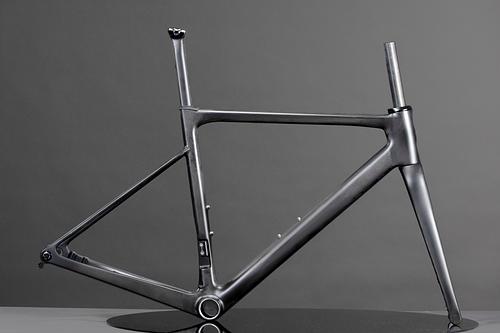
LTK266-D--SL
FrameThe LongTeng LTK266-D-SL is an open-mould lightweight road frame (claimed T1100/T1000/M65 carbon) with T47, UDH, a 27.2 mm seatpost and clearance for about 35-37 mm tyres; the same mould is sold as Tideace FM-CR266, Permeants ST-09 and 8bar Kronprinz Carbon V3. The frameset costs about $610, roughly $800-950 delivered, and weighs about 760 g (frame) and 315-325 g (fork), 866 g painted in size L. Builds of 6.3-6.9 kg are common, and owners describe a 'delightfully boring' ride: stiff, reliable and quiet, often compared to a Giant TCR with more tyre room, with several reporting no problems after 1,000 miles to 6,000 km. The traditional geometry has a short reach in the larger sizes, and one rider used to progressive fits found it slow on climbs and sold it. The frame itself rarely causes trouble; the supplied parts do: the seatpost wedge bolt is too long and can mark the carbon (use a 28-30 mm M5), the clamp may need a shim, the top headset bearing can be too tight or loose (owners use FSA ACR No.55 LS or Deda bearings), thru-axles and rail clamp bolts are low grade, and there is no FD grommet or Di2 battery holder. Paint is thin, and a few frames needed brake mounts faced or bottle bosses cleaned. Ordering through Alisa (ltbikes.com) is reported as easy, with delivery in two weeks to a month; XL and XXL have been in stock since April 2026, and the stated rider weight limit is about 100 kg.
AI Summary
Pros
- Very light: frame about 760 g and fork about 320 g, with complete builds of 6.3-6.9 kg
- Calm, stiff and quiet ride that owners compare to a Giant TCR with more tyre clearance; 'boring in a good way'
- Durable so far: no problems reported after 4,970 km, 6,000 km and 1,000 miles including a hilly century
more pros in the review
Cons
- Seatpost wedge bolt is too long and can press into the carbon; owners fit a 28-30 mm M5 bolt
- Stock seatpost clamp may not hold at spec torque; shims and higher torque were needed, and the rail clamp bolt rusts
- Supplied headset bearings vary: too tight to remove for some, loose for others; FSA or Deda bearings fit
more cons in the review
Key Points
- Same mould as Tideace FM-CR266, Permeants ST-09 and 8bar Kronprinz Carbon V3
- Weights: frame about 760 g, painted L 866 g, XL with hangers 835 g; fork 315-325 g; seatpost 150 g
- Builds: 6.28-6.9 kg typical; 7.2-7.6 kg with pedals and gravel or Zipp wheels
more key points in the review
LEESE LSE-C01
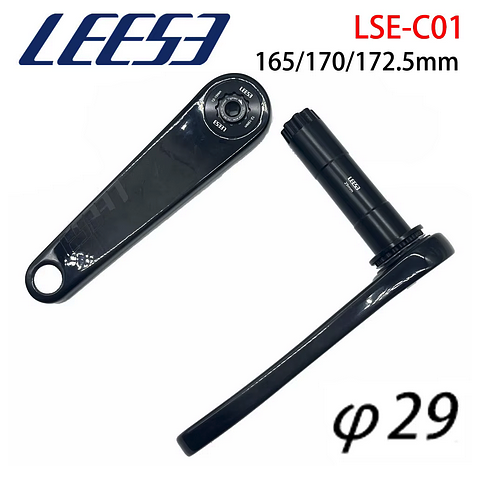
CrankThe LEESE LSE-C01 is a cheap carbon crankset from AliExpress (about $118-150), with carbon arms, CNC aluminium parts and a DUB spindle; a 'Max' version has a 24 mm titanium spindle. It comes in many lengths down to 135 mm and with Easton, 3-bolt and direct-mount interfaces; Leese no longer makes the 8-bolt version. Arms plus spider weigh about 330-400 g. Owners who got it set up are happy: one calls it bulletproof after a year, and direct-mount double rings proved 40 g lighter and much stiffer than a Goldix spider setup. Installation is the catch: - getting the chainline right with Shimano 2x and a BSA bottom bracket takes careful spacer work. Some need 1.5-4 mm on the drive side, and too many spacers can bind the bearings. The 24 mm cranks are more sensitive to spacer tolerance than Shimano, so check for micro-play with a feeler gauge; - 24 mm titanium-axle sets have loosened mid-ride; - the plastic preload adjuster can break, though sellers sell spares cheaply; - the measured Q-factor was 154 mm, against a claimed 150 mm. Instructions are poor, chainrings can wobble, and carbon rings shift less crisply than Shimano or SRAM ones.
AI Summary
Pros
- Light: about 330-400 g for arms plus spider.
- Short lengths down to 135 mm that big brands rarely offer.
- Good value and durable once set up; one owner reports a year of trouble-free riding.
more pros in the review
Cons
- Setup is not plug-and-play: chainline with Shimano 2x needs careful spacers, causing front derailleur rub or poor shifting, and too many spacers bind the bottom bracket.
- The 24 mm titanium-spindle (Max) version has come loose mid-ride for some riders.
- Poor instructions and unclear tool requirements.
more cons in the review
Key Points
- Price about $118-150 on AliExpress.
- Arms plus spider about 330-400 g.
- Carbon arms, aluminium spider, CNC parts; DUB spindle or 24 mm titanium spindle (Max).
more key points in the review

Elitewheels EDGE
WheelsThe ELITEWHEELS EDGE wheelset is discussed primarily in the context of noise issues, particularly creaking or clicking sounds from the rear wheel under high torque or power output (above 200-250W), often during uphill climbs or low cadence situations. Users report isolating the noise to the rear wheel through component swaps, with potential causes including the cassette (especially with certain brands like Goldix), spokes touching each other, or hub/bolt issues. Some users note the noise appears more frequently on hotter days. The wheels are compared to similar models like Yuanan wheels, and troubleshooting involves checking the bottom bracket, seat post, pedals, and through axle torque as alternative noise sources.
AI Summary
Cons
- Rear wheel creaking or clicking noise under high torque/power output (above 200-250W), especially during uphill climbs or low cadence
- Noise potentially caused by cassette issues (e.g., with Goldix cassettes), loose bolts, or poor tolerances
- Spokes touching each other identified as a possible source of noise by bike mechanics
Key Points
- Noise typically occurs under high torque (above 200-250W)
- Often isolated to rear wheel through component swapping
- Similar issues reported with comparable wheelsets like Yuanan
more key points in the review
ELVES Falath EVO+
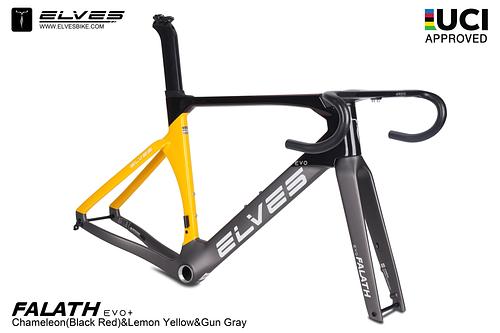
FrameThe ELVES Falath EVO+ Carbon Road Disc Frameset is a 2023 aero road bike frameset that has generated significant discussion. Key attributes mentioned include: price around $1100-$1300 USD, frame weight approximately 1300g for size 54, carbon construction with some fiberglass in steerer, T47 bottom bracket (EVO+ model), UCI certification, ISO 4210 testing, and proprietary integrated cockpit. The geometry is polarizing with very short top tubes on most sizes except the 61cm which has unusually long reach, creating fit challenges. The design features aggressive aero tube shapes but has been criticized for rectangular profiles and questionable aerodynamic optimization. Delivery times range from 4-10 weeks with custom paint options available.
AI Summary
Pros
- Aggressive aero design looks fast and distinctive
- Good value for money with custom paint options available
- Stiff and responsive ride quality
more pros in the review
Cons
- Polarizing geometry with very short top tubes on most sizes
- Heavier than expected (1300g for size 54)
- Questionable aerodynamic design with rectangular tube profiles
more cons in the review
Key Points
- Frame weight ~1300g (size 54)
- Price $1100-$1300 USD
- Carbon construction with fiberglass in steerer
more key points in the review
BXT-SL-115
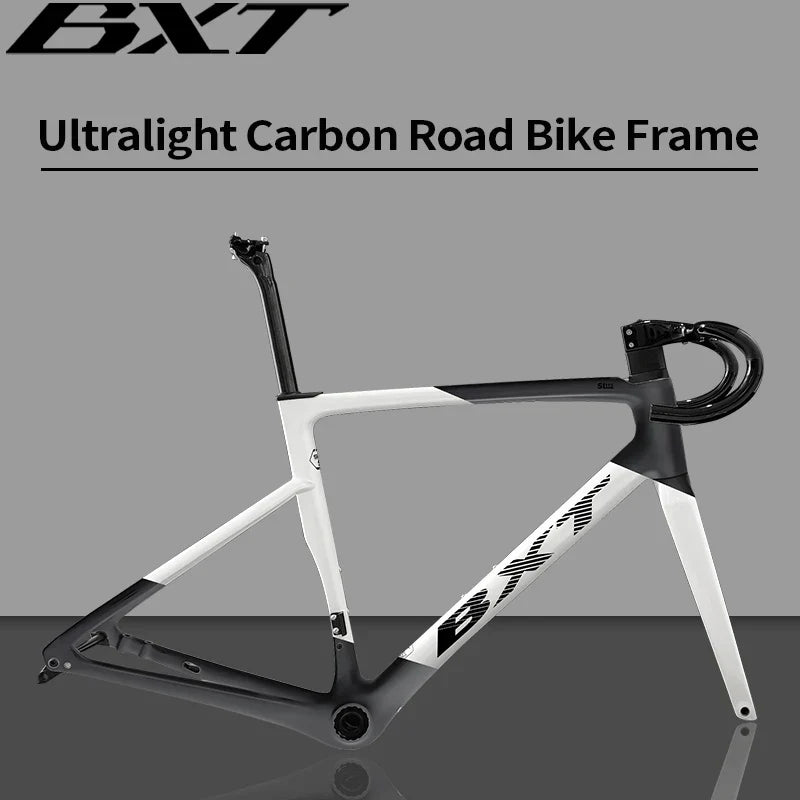
FrameThe BXT-SL-115 is a lightweight carbon fiber road bike frame purchased primarily through AliExpress/BXT Official Store. Users report frame weights around 962g (size 52cm) with derailleur hangers, and complete builds weighing 8.08-8.8kg. The frame features chameleon paint that changes color based on lighting, integrated handlebars, and a T47 bottom bracket. It accommodates various groupsets (Tiagra, 105, Ultegra) but requires careful component compatibility. Delivery typically takes 18+ days with additional shipping fees. The ride is described as stiff and responsive, though steering can be twitchy with a slammed stem. Tire clearance is limited to approximately 32mm.
AI Summary
Pros
- Lightweight carbon frame (around 962g for size 52cm)
- Customizable paint and logo placement options available
- Stiff and responsive ride quality, good for sprints
more pros in the review
Cons
- Included T47 bottom bracket is very tight, causing installation issues
- Limited tire clearance (max ~32mm, not suitable for 35mm gravel tires)
- Missing cable grommets for derailleurs and front brake, only rear brake hose grommet included
more cons in the review
Key Points
- Frame weight: ~962g (size 52cm)
- Paint: Chameleon gloss color-changing
- Bottom bracket: T47 68mm
more key points in the review

ZRACE XG4 Flat Mount
Disc-Brake-PadsThe ZRACE XG4 is a flat mount four-piston caliper discussed as a budget-friendly alternative to premium options like Hope RX4+ and Shimano 9270/8170. Users note it's a copy of the Hope RX4+ design, offering significant weight savings (around 70g lighter than Shimano 8070 calipers) at a much lower price point (under €80 delivered). Concerns exist about potential issues with bleeding, pad clearance, and reliability, similar to problems reported with the original Hope RX4. It's suggested that bleeding may require specific kits, and user experiences are limited, with recommendations to seek more information on specialized forums.
AI Summary
Pros
- Significant weight savings compared to Shimano 8070 calipers (about 70g lighter)
- Very affordable price (under €80 delivered), making it a low-risk option
- Considered an improvement over older 11-speed Shimano calipers for braking performance
Cons
- Potential bleeding and pad clearance problems, similar to issues with Hope RX4 calipers
- Limited user experiences and reviews available, making reliability uncertain
- Lacks the sharp initial bite that some users prefer in Shimano calipers
Key Points
- Flat mount four-piston design
- Copy of Hope RX4+
- Weight savings of ~70g vs. Shimano 8070
more key points in the review
ICAN Cycling Flyee (Triaero)
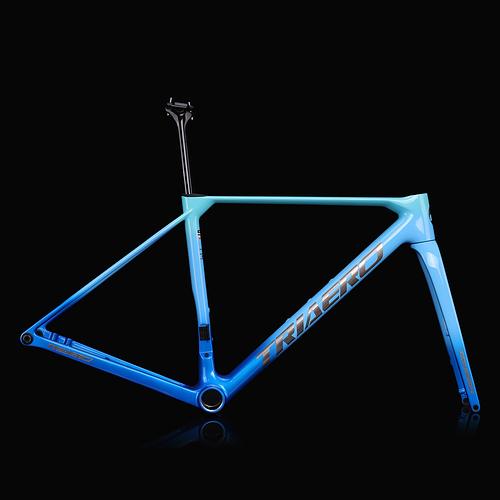
FrameThe ICAN Cycling Flyee is a custom carbon road bike frame that users build up with their own components. Based on forum discussions, it's positioned as an affordable carbon frame option (frame + bar for $1,199) that offers a geometry described as "a really nice combination of snappy and responsive but also a little more upright and comfortable." The frame features full internal cable routing, T47 bottom bracket, and disc brake compatibility. Users report positive riding experiences with improved performance compared to other bikes, though the build process requires technical skill, especially for internal routing.
AI Summary
Pros
- Good geometry that balances responsiveness with comfort
- Affordable carbon frame option compared to major brands
- Rewarding build experience for DIY enthusiasts
Cons
- Difficult internal cable routing, especially through handlebars
- Potential quality control issues with threads and components
- Requires significant technical skill and tools for assembly
Key Points
- Frame + bar cost: $1,199
- T47 bottom bracket
- Full internal cable routing
more key points in the review
ICAN Cycling Flyee (Triaero)
FrameThe ICAN Cycling Flyee is a lightweight carbon road bike frameset that resembles the Orbea Orca geometry. It features a T47 bottom bracket, UDH (Universal Derailleur Hanger), generous tire clearance (up to 35c), and a higher stack geometry that many users appreciate for comfort. The frame weighs approximately 880g (size 52) with the fork at 362g. It comes with a carbon seatpost with a carbon cradle, though some users prefer metal alternatives. The frame is noted for its attractive paint quality and clean internal routing. However, several users reported quality control issues, particularly with the front fork threads and unfaced bottom bracket and disc mounts. The price is competitive, and shipping is fast, but additional costs may arise from needed repairs or replacements.
AI Summary
Pros
- Lightweight frame (880g for size 52) and fork (362g)
- High stack geometry (144mm headtube for XL) for comfortable riding position
- Generous tire clearance (fits up to 35c tires easily)
more pros in the review
Cons
- Quality control issues: front fork threads were stripped/damaged, requiring tapping
- Bottom bracket and disc caliper mounts were not faced
- Carbon seatpost cradle is disliked; users prefer metal for durability
more cons in the review
Key Points
- Weight: Frame 880g (size 52), Fork 362g
- Geometry: High stack, short chainstays (408mm), 72-degree head tube angle
- Tire Clearance: Fits up to 35c tires
more key points in the review
XMCS GRT
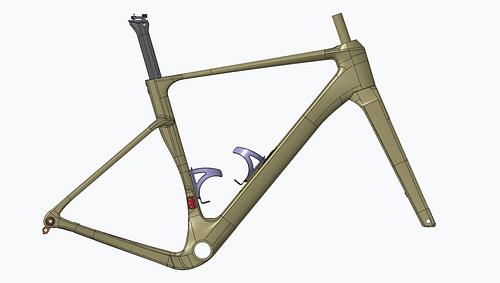
FrameThe XMCS GRT is an aero gravel race frame designed with forum member Requiem84 and shown at Eurobike 2026, with 57 mm official tyre clearance, in-frame storage, UDH, T47 85.5 mm, an FSA ACR headset and a proprietary aero seatpost. The frame lists at USD 1490 (about $2000 with bar and shipping). First customer frames arrived in October 2026: a size S weighs 1096 g in clear coat, an XL 1370 g painted, the fork about 470 g; builds range from 7.4 kg in road spec to about 9 kg with 2.25 in tyres. Owners measure 55.5 mm tyres with 7 mm per side and 63 mm tyres with 4 mm at the chainstays. In October 2026 XMCS updated the moulds: the new chainstays take a 1x 48-50T ring (52T with a spacer) and GRX 50/34, while the first frames take 46T 1x and GRX 48/31; the website still defaults to 46T, so the new mould has to be requested. Ride reports call it comfortable, stable and very fast downhill, with one owner finding the steering quicker than expected. XMCS's aero test puts it 11 W slower than its VRT road bike at 35 km/h. Paint and caliper mounts are well finished; criticism centres on the logo, inconsistent information between XMCS's websites and email answers, and missing details like a downtube protector and storage bags.
AI Summary
Pros
- Very large real clearance: a 2.2 in tyre (55.5 mm) leaves about 8 mm everywhere, and 63 mm tyres still have 4 mm at the chainstays
- Aero but comfortable: XMCS measured 11 W slower than the VRT at 35 km/h, and owners report a smooth, compliant rear
- Stable, confident handling on rough descents; races and singletrack reports are enthusiastic
more pros in the review
Cons
- Original moulds limit 1x chainrings to 46T; the website still defaults to that version, so buyers must ask for the updated mould
- Conflicting information between XMCS websites, slow email replies and at least one wrong handlebar shipped; WhatsApp sales reps answer best
- Front derailleur clearance with large rear tyres untested; about 50 mm is the expectation with 2x, 45 mm with SRAM or Campagnolo 13-speed
more cons in the review
Key Points
- Official tyre clearance 57 mm; 2.4 in (61-63 mm WAM) fit with 4-5 mm
- T47 85.5 mm, UDH, flat mount, proprietary aero seatpost (Shimano Di2 battery holder in the post)
- Headset FSA ACR, upper bearing 40x51.8x8 45/36, OD1 steerer
more key points in the review
Bryton Rider S810
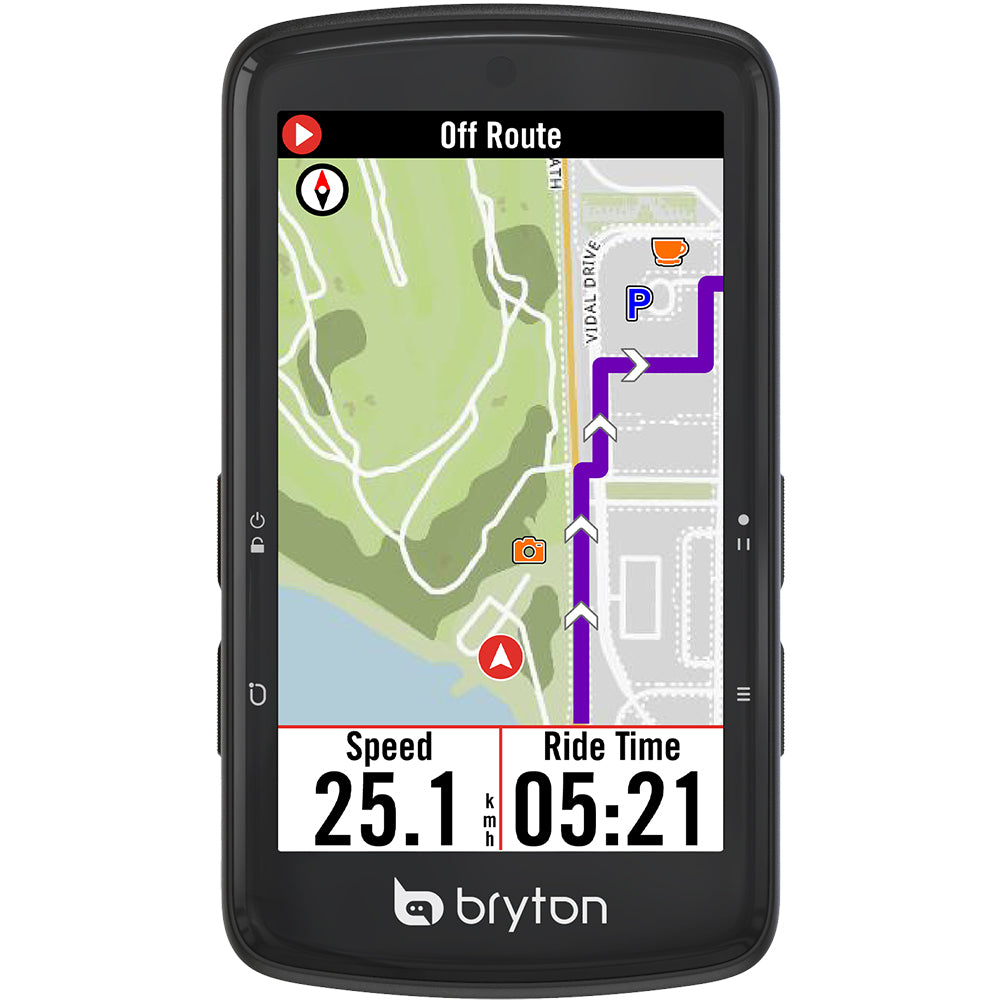
Bike-ComputersThe Bryton Rider S810 is a Taiwanese bike computer with a large screen size comparable to Garmin Edge 1050. Users report generally solid build quality, excellent battery life (lasting weeks with daily use), and good compatibility with sensors like HRMs, cadence sensors, power meters, and smart trainers. Navigation works well with route syncing via RideWithGPS and Strava. However, some users experience connectivity issues with devices like power meters and Di2, slow GPS lock, and a clunky UI with buried menus. The screen resolution is undisclosed but appears lower than competitors like Karoo 3. Software updates have improved features like SRAM eTap integration.
AI Summary
Pros
- Excellent battery life lasting weeks with daily use including long rides
- Good compatibility with various sensors and devices including HRMs, cadence sensors, power meters, and smart trainers
- Reliable navigation with route syncing via RideWithGPS and Strava, working internationally
more pros in the review
Cons
- Connectivity issues including slow power meter connection and frequent dropping of Di2 gear status
- Slow GPS lock time compared to other devices
- Clunky UI with buried menus and unintuitive device shutdown process
more cons in the review
Key Points
- Large screen size similar to Garmin Edge 1050
- Battery life up to 50 hours claimed
- Works with RideWithGPS and Strava syncing
more key points in the review
Speeder Cycling Carbon Integrated Road Disc Frameset (SC-R55D)
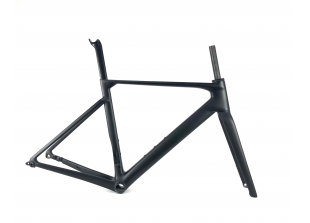
FrameThe Speeder Cycling SC-R55D is a carbon integrated road disc frameset that has generated significant discussion among forum users. Key attributes include a price of approximately $660 for the frameset plus shipping, frame weights ranging from 842g (unpainted size 535) to 930g (painted size 51), and material using Toray M40J T700/T800 carbon (with later mentions of T800/1100 and MJ40). It features BB86.5 press-fit bottom bracket (with T47 option later available), full internal cable routing, Di2 compatibility, flat mount disc brakes, UDH (Universal Derailleur Hanger), and max tire clearance of 700x32c (though users report fitting up to 34-35mm actual width, and one user fits 34c Vittoria Corsa with room to spare). The frame comes in sizes from 45cm to 57cm with integrated handlebar/stem options. Users generally praise the frame's quality, value, and performance, with long-term reviews (8,000-13,000 km) reporting minimal issues. Noted drawbacks include the BB86 bottom bracket, seatpost clamp design (slipping, hard to reach saddle bolt), and occasional communication delays with Speeder. Recent posts highlight progressive geometry (long reach, moderate stack) and the ability to achieve sub-7.4kg builds. The carbon layup has been updated to Toray M40J T800/T1100.
AI Summary
Pros
- Excellent value for money with high-quality finish and construction
- Good weight for an aero frame (780g-930g depending on size and finish)
- Stiff and responsive; one racer finds it stiffer than a Yoeleo R6 and comparable to a SuperSix EVO Hi-Mod.
more pros in the review
Cons
- BB86 bottom bracket can be problematic (undersized, creaking issues)
- Seatpost clamp design is problematic (slipping, creaking, difficult to adjust)
- Inconsistent communication and slow response times from Speeder
more cons in the review
Key Points
- Toray M40J T700/T800 carbon construction (later T800/1100)
- BB86.5 press-fit bottom bracket (T47 option available)
- UDH (Universal Derailleur Hanger) compatible
more key points in the review