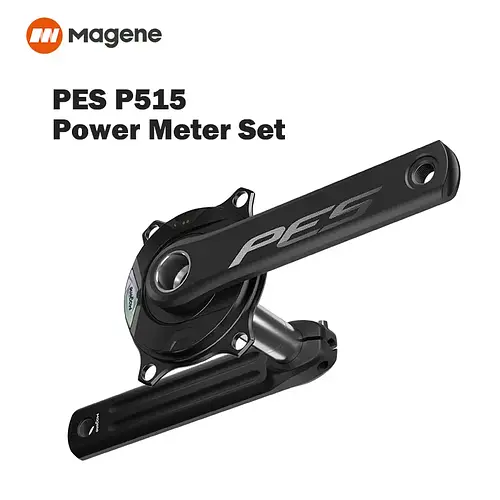

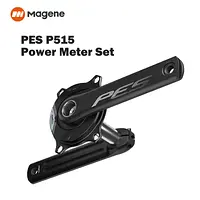
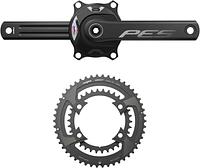
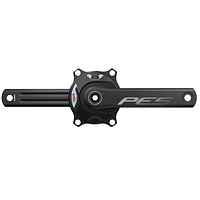
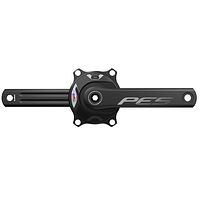
The Magene PES P515 is a spider-based power meter crankset that is widely praised as exceptional value at roughly €200-300, with most reviewers and owners finding it accurate (typically within 1-2% or a few watts of reference pedals and smart trainers) once calibrated. Its 24 mm Shimano-compatible spindle, 110 BCD four-bolt interface and straightforward installation make it a near plug-and-play upgrade, and battery life is long (claimed 240-380 h depending on version). The recurring weaknesses are a left crank arm that can work loose, creaking from the crank-to-spider interface after a few thousand kilometres, a proprietary crank interface, and firmware/connectivity hiccups; chainring choice matters, with standard Shimano road rings fitting best and GRX rings not fitting.
Pros
- Exceptional value: street prices around €200-300 (one buyer paid £225, another €250 with coupons), well below comparable Shimano or SRAM power meters.123
- Accurate and consistent power data, typically within 1-2% or a few watts of reference pedals and smart trainers once calibrated.421
- Straightforward installation as a direct swap for Shimano 24 mm cranksets, using standard tools and a 44 mm 16-notch lockring tool.516
- Long battery life (claimed 240-380 h depending on version) with convenient magnetic charging.789
- Compatible with standard Shimano 110 BCD road chainrings (105, Ultegra, Dura-Ace) which shift well; also works with many aftermarket rings and 1x gravel builds.624
- Crank stiffness comparable to Shimano Ultegra, with no noticeable flex when sprinting or climbing.110
- High water resistance (IPX7) and robust build quality with CNC-machined aluminium crank arms.8109
- Provides cadence and left/right pedal balance (estimated) plus pedalling efficiency metrics.5810
- Good customer support in some cases: Magene replaced a creaking unit under warranty fairly quickly.6
Cons
- Left crank arm can work loose over time; most fix it with correct torque and threadlocker, but some owners gave up despite every tip.27
- Creaking or clicking under load after a few thousand kilometres, traced to the crank-to-spider interface; regreasing fixes it temporarily for some.6
- Proprietary crank interface means only Magene crank arms fit; not as easy to swap between bikes as pedal-based power meters.695
- Out-of-the-box accuracy can be off by 4-6.5% compared to reference pedals, requiring a calibration offset in the app.49
- Chainring limitations: GRX rings do not fit (31T inner is too small for 110 BCD), third-party rings can shift worse, and Magene's own chainrings have inferior shift quality compared to Shimano.27
- Firmware issues: v0.118 can brick the unit or cause 0W readings, requiring a force reset via nRF Connect; some users report persistent connectivity problems.112
- Heavier than carbon cranksets: aluminium PES is about 625-649 g (about 800 g with rings), and the carbon TEO saves roughly 200 g but needs a DUB bottom bracket.24
- Some plastic parts (e.g. preload ring/cap) are fragile and can be damaged if overtightened; early one-piece preload bolts got lost or stuck.862
Key Facts
- Weight varies by configuration and source: claimed 625 g for the aluminium PES crankset, measured 649 g for 175 mm arms with bolt, about 800 g with Ultegra rings; the carbon TEO version is about 425 g with a 29 mm DUB spindle.2810
- 24 mm steel spindle compatible with Shimano Hollowtech II bottom brackets, 110 BCD four-bolt chainring interface; the carbon TEO version uses a 29 mm SRAM DUB spindle.657
- Claimed accuracy ±1% (improved from ±1.5% on the P505) with active temperature compensation; most owners see readings within 1-2% or a few watts of trainers such as the Tacx Neo.627
- Claimed battery life ranges from 240 h to 380 h depending on version and source, with magnetic USB charging and roughly 3-4 hours recharge time.2810
- IPX7 water resistance (submersible to 1 m for 30 minutes), ANT+ and Bluetooth connectivity, and a Q-factor of 147 mm.891
- Available in crank lengths from 165 mm to 175 mm in 2.5 mm increments; chainring options include 50/34, 52/36 and 53/39 in 110 BCD.1052
- Installation torque specs: lockring 35-40 Nm, crank arm preload 1.5-2 Nm, crank bolt 12-14 Nm, outer ring 13-15 Nm, inner ring 10-12 Nm; a 44 mm 16-notch lockring tool is required.856
- Firmware updates are delivered over Bluetooth via the Magene app; versions v0.118/v0.119 (2026) improved behaviour, though some users reported spikes or bricked units after updating.6211
Sources
- 1David Arthur - Just Ride BikesI Bought a Cheap Power Meter to Get Faster… Big Mistake or Big Win?
- 2Rennrad-NewsMagene Powermeter
- 3Grumms on ChinertownMagene P515 : a nice powermeter, works well on my Wahoo Bolt and my Coros Pac...
- 4Tom Bowers CyclingThe Best Deal in Cycling? Magene PES 515 Review (With One Catch)

- 5MIKE ON BIKEMAGENE PES515 Powermeter im Test ➡️ UNPACKING - MONTAGE - FAZIT

- 6ChinertownMagene P515 PES Spider Powermeter
- 7Patrick LinoUpgrade Your Shimano Cranks RIGHT NOW! - Magene PES P515
- 8JULEZ | CYCLINGMagene P515 vs. Realität – Wie genau ist der günstige Powermeter? Unboxing, Aufbau und Test

- 9henrychungfitnessMagene PES515 Budget Power Meter Crankset

- 10TheItalianCyclingVLOG🇮🇹2 sources


- 11r/cyclingmagene pes p515 stuck at 0w fix
Reviews & Ratings
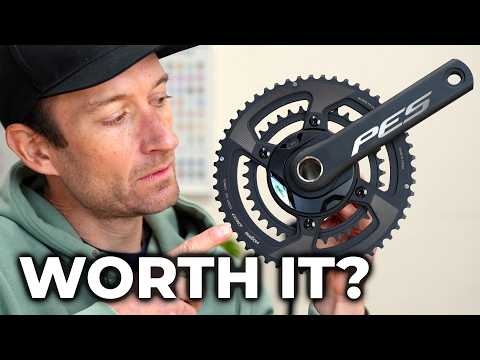
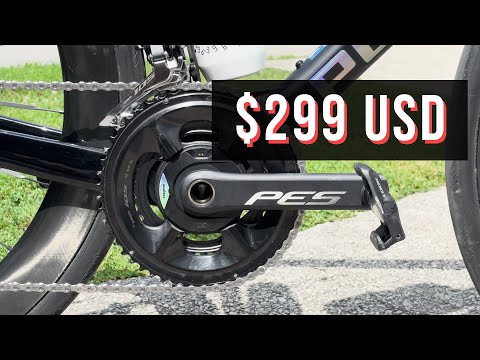
04:40The reviewer tested the Magene PES P515 Base Power Meter Crankset for a month and found it to be a well-manufactured, accurate budget option. It is an aluminum CNC machined crankset with a 24mm spindle, available in crank lengths from 165mm to 175mm. The power meter can be paired with either the PES aluminum crankset or the Magene KO carbon crankset, and it accepts four-bolt chainrings, including Shimano and other standard chainrings. Priced at $299 USD for the power meter alone, or around $350 with chainrings, it offers good value. The reviewer noted that it reads about 4% higher than Garmin Vector 3 pedals and a Wahoo Kickr Core V2, but after offsetting, the data is quite close. Installation is straightforward but requires careful attention to torque settings to avoid stripping screws. The reviewer recommends it for those who leave their power meter on the bike, not for those who switch often.
16:20The reviewer presents the Magene PES P515 Base Power Meter Crankset as a successor to the P505, which he used for years without issues. He praises its improved design, lighter weight, longer battery life, higher accuracy, and exceptional value for money at €299. He highlights its compatibility with Shimano 24mm bottom brackets and 11-12 speed groupsets, and notes it can be paired with Magene CAD chainrings. He plans to install it on his bike and expects excellent performance.
09:59The reviewer discusses the Magene PES P515 Base Power Meter Crankset after using it for 100-2000 km on a Quota K1 bike. He praises its excellent quality-price ratio, calling it the cheapest power meter crankset on the market at €299, with improved accuracy of around 1% error, lightweight aluminum 7075 construction at 600-620g, and battery life updated to about 320-330 hours. He notes it is reliable, stiff, and widely available in Italy, but mentions the chainrings are only available in Shimano ratios (53/39, 52/36, 50/34) and not yet in 54/40. He recommends it for its performance and value.
13:16The reviewer tested the Magene PES P515 Powermeter-Set, a crank-based power meter that is a more affordable alternative to the pedal-based P715. They found it to be a good power meter that provides accurate and consistent data at a reasonable price, with performance comparable to the more expensive P715 and a smart trainer. The installation process was detailed, and the reviewer highlighted the need for careful handling of plastic parts and proper torque specifications.
17:32The reviewer chose the Magene PES Crank P515 Power Meter after extensive research, comparing it to other power meters like Favero pedals and smart trainers. They highlight its accuracy, dual-sided measurement, and affordability at around €300. The reviewer installed it on their own bike, noting the process is straightforward with basic tools. After 4,500 km of use, they report no issues, no creaking, and improved comfort due to the shorter crank length (170 mm vs. previous 175 mm). They recommend it for cyclists with a single bike who want an accurate, cost-effective power meter.
16:07The reviewer tests and reviews the Magene PES515 power meter, which is a spider-based power meter that comes with a PES crankset. They detail the unboxing, installation on a bike with a Shimano groupset, and extensive testing against other power meters. The reviewer notes the initial accuracy was off by 4-5% compared to their reference pedals, but after applying a calibration offset in the app, it showed excellent precision and repeatability. They conclude it is a very affordable option that requires some user calibration to achieve accuracy.
09:15The reviewer purchased the Magene PES P515 power meter crankset from AliExpress for £225 to improve their winter training. They were greatly impressed with the results and found no downsides. The reviewer found installation straightforward as a direct replacement for their Shimano Ultegra crankset. They tested the power meter's performance against Wahoo Powrlink dual-sided pedals and found the data to be accurate, consistent, and reliable, though it read slightly higher. The crank stiffness was comparable to Ultegra, and the shifting performance of the chainrings was very good, nearly matching Shimano's gold standard. The reviewer concludes it scores really well, especially considering its significantly lower price compared to competitors.
14:02The reviewer discusses the Magene PES Crank P515 Power Meter extensively, highlighting its updates from the previous PES505 model. They mention its compatibility with Shimano standards, improved accuracy, lighter weight, longer battery life, and support for T47 and BB 386 bottom bracket standards. The reviewer compares its data accuracy against their indoor smart trainer and finds it to be reliable, especially during sustained efforts. They also note the importance of proper installation to avoid loose play issues.
A user reports that updating the Magene PES P515 power meter to firmware v0.118 caused it to get stuck at 0W and fail calibration. Magene support provided a force reset method using nRF Connect to send a 'reset' command via the Nordic UART Service. The fix resolved the issue for the original poster, but other users report persistent connectivity problems and bricked units even after the reset. Some users advise against updating, and there are complaints about poor support and app limitations.
AI Summary
Pros
- Affordable power meter option
- Force reset method available from support
- Quick support response for some users
Cons
- Firmware v0.118 can brick the unit or cause 0W reading
- Force reset requires technical knowledge and third-party app
- Magene Utility app is basic and lacks advanced features
more cons in the review
Key Points
- Firmware v0.118 caused calibration failure and 0W reading
- Force reset command: 'reset' via Nordic UART Service (UUID 6E400001) RX characteristic
- nRF Connect app required for force reset
more key points in the review
The Magene PES P515 is a spider-based power meter on an aluminium 24 mm Shimano-standard crankset with a 110 BCD spider. Owners in the rennrad-news thread rate it as very good value and mostly accurate, typically within a few watts of trainers such as the Tacx Neo. The recurring weakness is the left crank arm, which is held by a single clamp design and works loose for some riders even with threadlocker; one owner gave up and switched to the rebadged GeoID PM500, whose left arm clamps with two bolts and which costs about EUR 90 less for about 50 g more, so some owners would now pick it instead. Chainring choice matters: standard Shimano road rings fit and shift best, GRX rings do not fit (Stone 110 BCD 46/32 rings are the gravel workaround), and third-party rings can shift worse. The TEO P515 uses the same electronics on carbon arms with a 29 mm DUB spindle (about 425 g vs 625-649 g). Firmware updates come through the Magene app. Street prices are around 200-240 EUR from AliExpress EU warehouses; during the November 2026 sales one buyer had cheap 160 EUR orders cancelled after an 11-day countdown, while orders from the French warehouse arrived normally.
AI Summary
Pros
- Very good value; AliExpress EU-warehouse prices of roughly 200-240 EUR are common, well below Shimano or SRAM power meters
- Accurate for the price; most owners see readings within 1-2% or a few watts of trainers such as the Tacx Neo.
- Straightforward installation on standard Shimano 24 mm (Hollowtech II) bottom brackets.
more pros in the review
Cons
- The left crank arm can work loose over time; most fix it with correct torque and threadlocker, but at least one owner sold his because it kept loosening despite every tip.
- GRX chainrings do not fit: the 31T inner ring is too small for 110 BCD and the GRX outer ring is bolted from the other side; Stone 46/32 110 BCD rings work but cost about 125 EUR
- Shifting can suffer with third-party chainrings such as Alugear or Pass Quest; Pass Quest advises not to mix their rings with others.
more cons in the review
Key Points
- Spider-based power meter measuring combined power at the spider, with cadence.
- PES P515: aluminium crank arms, 24 mm Shimano-standard spindle, about 625 g claimed (649 g measured, 175 mm with bolt)
- TEO P515: carbon crank arms, 29 mm SRAM DUB spindle, about 425 g; same power electronics as the PES.
more key points in the review
The Magene PES P515 is a spider-based power meter crankset (24 mm steel spindle, 110 BCD 4-bolt), the successor to the P505: about 25 g lighter, rated at 1% instead of 1.5%, with active temperature compensation and better T47 compatibility; the carbon TEO version uses a 29 mm spindle. It costs around EUR 250 and is bought from Magene's AliExpress store in Europe or Magene's site in the US, avoiding region-locked Chinese units. Owners find it accurate when calibrated (also with oval rings, thanks to continuous angular velocity measurement), easy to install with a 44 mm 16-notch lockring tool, and compatible with Shimano 105/Ultegra chainrings, GRX and many aftermarket rings; firmware updates (v0.118/v0.119) improved behaviour, though one user saw spikes after updating. The recurring problem is creaking or clicking under load that returns after a few thousand km. Magene says it comes from the crank-to-spider interface, replaced one unit under warranty, and owners silenced it by greasing that interface generously and torquing it fully; others report 4,000 miles without noise. Other niggles: a proprietary crank interface (Magene arms only), early one-piece preload bolts that got lost or stuck, an occasional lockring thread defect, narrow chainring bolt holes that make GRX chainring nuts awkward (Alugear bolts work), lost crank bolt O-rings, spacers needed on some frames, and patchy Bluetooth and customer support. A revised drive-side-bolt crankset was shown in Shanghai.
AI Summary
Pros
- Good value around EUR 250 with 1% claimed accuracy and temperature compensation
- Accurate when calibrated, also with oval chainrings
- Easy installation with standard tools and a 44 mm 16-notch lockring tool
more pros in the review
Cons
- Creaking or clicking under load after a few thousand km, which regreasing only fixes temporarily for some; Magene points to the crank-to-spider interface
- Proprietary crank interface: only Magene arms fit
- Early preload bolts were one-piece and got lost or stuck; replacements are hard to source
more cons in the review
Key Points
- 24 mm steel spindle; 110 BCD 4-bolt spider; TEO carbon version with 29 mm spindle
- About 25 g lighter than P505; claimed 1% accuracy; active temperature compensation
- Compatible with T47 (68 and 86 mm) and Shimano BSA BBs; spacers needed on some frames
more key points in the review
Magene P515 : a nice powermeter, works well on my Wahoo Bolt and my Coros Pace. 250€ with coupons
My short experience with P515.
Sale via Ali from the EU shop went very well, delivery took 3-4 days more then expected. Crank looks very good, marginal heavier than the 105. Assembly was also no problem, I ordered it with the QED chainrings. Installation on my Lightcarbon LCR017 was not a big problem, I did however have to add a spacer on the drive side because otherwise there would have been play between the two arms. First 100k tour was also problem-free, recording in. Compared to the power meter pedals seems to be lower in the numbers, maybe still needs to be calibrated. What I also noticed is that the QED chainrings are louder than my 105 crank.
I hope this can help you a little.
Best regards.
JULEZ10PATRICKLINOPattyL75Where to Buy
| Rating | ||||
|---|---|---|---|---|
 pandapodium.cc Affiliate · MyBikeParts | – | – | 0.0(0) | |
 aliexpress.com #1005005506880823Affiliate · MyBikeParts Magene Official Store5.0/5 · 98% positive | 4.6(171)1,000+ sold | |||
| aliexpress.com #1005006125676751Affiliate · MyBikeParts Magene Official Store5.0/5 · 98% positive | 4.7(90)364 sold | |||
 amazon.de Affiliate · MyBikeParts | – | – | 4.3(59) | |
| amazon.de Affiliate · MyBikeParts | €273 | – | – | 5.0(1) |
| amazon.de Affiliate · MyBikeParts | €273 | – | – | 5.0(1) |
| – | $269 | – | 4.6(5) | |
| €242 | – | – | 5.0(1) |

Price history
Each shop's price, every time we checked · last 2 years
Specifications
Attributes
Spotted an error in the specs? Help us correct it — sign in or create an account.
Mentioned in videos
These videos name the Magene PES P515 Base Power Meter Crankset without assessing it — no pros or cons, so they do not count as reviews.

Questions about Magene PES P515 Base Power Meter Crankset
Price & value
1Compatibility
5Build & setup
6Ride & performance
4Durability & quality
2Other questions
1Sign up and share your experience — help other riders decide!
Create Account & Review