


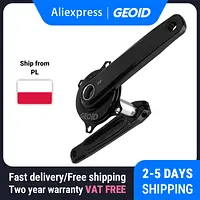
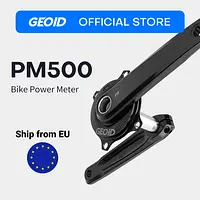
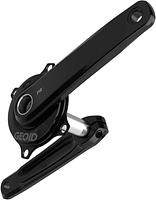
The GEOID PM500 is a budget spider-based power meter crankset that offers good value, with accuracy generally within ±1.5-2% for steady efforts, but it is heavier than comparable Shimano cranks and has a proprietary crank interface that limits chainring and crank arm compatibility. Some users report reliability issues including 0W failures and calibration difficulties, though customer support has provided replacements. It is widely considered a rebranded Magene P505/P515 and a solid entry-level option for riders prioritizing cost over precision in short efforts.
Pros
- Affordable: around $179 / €140 / £165, significantly cheaper than comparable power meters (often 2/3 the price of Magene P515).1234
- Accuracy within ±1.5-2% for steady efforts and intervals longer than 10 seconds, comparable to Favero Assioma and Garmin Rally pedals.526
- Easy installation similar to Shimano cranksets with 24mm axle; includes tools and manual.327
- Long battery life of 300 hours, significantly longer than some pedal-based power meters.123
- Compatible with Shimano 105 11-speed chainrings (110 BCD 4-bolt) and Shimano bottom brackets.146
- Seamless sync with platforms like Zwift, TrainingPeaks, and Strava; pairs easily with Garmin/Wahoo via ANT+/Bluetooth.134
- Good thermal compensation; maintains calibration during temperature changes and after high-power sprints (unlike some competitors).57
- Senicx PR3 crank arms provide more clearance for front derailleurs than Magene PES505 arms.4
Cons
- Heavier than comparable cranksets: 680g vs Shimano 105 545g (about 100g more) and Magene P515 625g.5246
- Proprietary crank interface (Senicx PR3) not compatible with standard Easton, SRAM, or Shimano crank arms, limiting versatility.42
- Accuracy poor for very short sprints (1-3 seconds), with deviations up to 6-8%.2
- Some units have failed completely, showing 0W while still transmitting cadence; may require head-unit swap to recover, and cause not well explained.42
- Occasional data dropouts when connected via ANT+ (zero values for power and cadence); Bluetooth connection is more stable.2
- Chainline may be ~3mm shorter than Magene PES505, potentially causing chainstay clearance issues with 2x setups.4
- Power scaling (slope adjustment) in the Magene Utility app does not work, confirmed by support.7
- Included tool for installing/removing the cover plate is soft plastic and ineffective; a Shimano tool is recommended.2
Key Facts
- Weight: 680g for the complete crankset (claimed), measured 668-680g; about 100g heavier than Shimano 105 (545g) and 55g heavier than Magene P515 (625g).1246
- Price: approximately $179 / €140 / £165, often 2/3 the price of Magene P515 (1000 RMB vs 1500 RMB).1234
- Claimed accuracy: ±1.5%; independent tests show deviations of -1.5% to +1.7% for intervals longer than 10 seconds, but up to 6-8% for 1-3 second sprints.524
- Battery life: 300 hours, charged via magnetic cable.123
- Spindle: 24mm, compatible with Shimano bottom brackets; installation torque 34-40 Nm.534
- Chainring mount: 110 BCD 4-bolt, compatible with Shimano 105 11-speed chainrings; cranks use a proprietary interface (Senicx PR3) not compatible with other crank arms.146
- Connectivity: ANT+ and Bluetooth; pairs with Garmin, Wahoo, and major apps; uses Magene Utility app for setup and calibration.347
- Based on the same module as the Magene P515, sharing FCC registration images; considered a rebranded Magene P505/P515.246
Sources
- 1Crank & SprintsIs Commuting Making You A Faster Cyclist? We Tested It With GEOID PM500

- 2MyBikePartsGEOID PM500 im Langzeittest: genau genug, aber mit einem Problem

- 3Dave NoakesThe BEST Budget Power Meter?! Geoid PM500 Installation - AliExpress

- 4ChinertownGeoid PM500 power meter
- 5Веломастерская love.bikeМощемеры ПО НИЗУ РЫНКА: Geoid PM500, Leoseek

- 6r/bicyclinggeoid pm500 vs direct drive trainer power
- 7r/bicyclinggeoid pm500 vs tacx neo 2t test
Reviews & Ratings
 16:48
The reviewer chose the GEOID PM500 power meter crankset for his road bike build, wanting to test a power meter for the first time and finding options on AliExpress. He selected a 170 mm crank length based on intuition rather than any specific reasoning, noting that if it turns out too long he can lower the saddle a few millimeters. He paired it with a Goldix chainring using the 110 BCD four-bolt standard, with 50 and 34 teeth.
 37:12
The reviewer briefly mentions the GEOID PM500 Power Meter Crankset while assembling the bike's crankset and chainring. He notes that the power meter component was already installed and that an instruction manual was provided for the power meter, but not for the chainring. He expresses uncertainty about the correct orientation of the second chainring (whether it should be flipped or not). No performance, accuracy, or ride-quality feedback is given.
 19:53
The reviewer purchased the GEOID PM500 Power Meter Crankset for around €140 out of curiosity due to its low price. He tested it against a Favero Assioma power meter and found that while it provides usable power data, especially for longer intervals, it has accuracy issues in short sprints. The unit he received initially broke down, but he received a replacement. He notes that it is a rebranded version of the Magene P515, sharing the same module, and concludes that it is a good value for entry-level cyclists, though it has some limitations.
08:30The reviewer discusses the GEOID PM500 cycling power meter as an affordable entry-level option for cyclists who want consistent and reliable power data. They highlight its compatibility with Shimano 105 11-speed systems, lightweight design, long battery life, and accuracy of ±1.5%. The reviewer emphasizes that at $179, it provides meaningful data without the need for expensive alternatives.
14:42The reviewer tests the GEOID PM500 cycling power meter, which comes with cranks. They compare it to a cheaper spider-based power meter (Leico) and find the GEOID PM500 to be more accurate and reliable, especially after high-power sprints. The reviewer recommends the GEOID PM500 for its accuracy and value, noting it is a good option for those who need a power meter on a budget.
08:01The reviewer purchased the GEOID PM500 power meter set from AliExpress for about £165. It is a crank set with a direct mount spider power meter, not including a chainring. The reviewer finds it affordable, easy to install, and aesthetically pleasing. They tested it and confirmed it pairs with devices and provides power readings.
The GEOID PM500 cycling power meter is a budget-friendly option that appears to be a rebranded Magene P505 or P515 spider-based power meter. User tests show accuracy comparable to Garmin Rally pedals and direct drive trainers, but some concerns exist about potential offset shifts after high-power efforts, though not confirmed for this model. It is heavier than standard cranksets but offers good value for a second bike.
AI Summary
Pros
- Accuracy close to Garmin Rally pedals and direct drive trainers
- Significantly cheaper than Magene P515 (about 2/3 the price)
- Compatible with Shimano 4-bolt 110BCD cranksets
more pros in the review
Cons
- Heavier (680g) compared to standard 105 crank (545g)
- Potential offset shift after sprints (not confirmed for this model but seen in similar cheap meters)
- Limited long-term reliability data
Key Points
- Spider-based power meter, 4-bolt 110BCD, 24mm spindle
- Rebranded Magene P505 or P515
- Weight: 680g
more key points in the review
A Reddit user tested the Geoid PM500 power meter against a Tacx Neo 2T trainer and found it tracks well overall, with no offset issues after high-power efforts. It appears more responsive than the trainer but showed some cadence drops and a power drop without cadence change. Installation is straightforward, similar to Shimano cranks. However, a commenter noted the power scaling feature does not work, which is a drawback for users needing calibration.
AI Summary
Pros
- Tracks Tacx Neo 2T accurately overall
- No offset problems after 1000+ watt efforts
- More responsive to sudden power increases than the trainer
more pros in the review
Cons
- Power scaling (slope adjustment) does not work, confirmed by support
- Some cadence drops observed (possibly glitches)
- One unexplained power drop without cadence change
Key Points
- Spider-based power meter, 4-bolt 110BCD, 24mm spindle
- Compatible with Shimano direct drive (MTB) interface
- Tested against Tacx Neo 2T with 2-second offset and 1-second smoothing
more key points in the review
The GEOID PM500 is a spider-based power meter with 4-bolt 110BCD 24mm interface, widely discussed as a rebranded or similar version of the Magene P505/P515. Users report it's typically priced between $170-$250, with weights around 668-680g including cranks. It uses a proprietary crank interface (paired with Senicx PR3 cranks) that is not compatible with other crank arms. The Senicx PR3 arms are more outward curved than Magene PES505, offering better front derailleur clearance, but the chainline is about 3mm shorter, which may cause chainstay clearance issues in some 2x setups. The power meter features ANT+/Bluetooth connectivity, claims ±1.5% accuracy, and works with Magene app and major cycling computers. User experiences on accuracy are mixed: some report good correlation after calibration, while others see -2-3% deviation vs smart trainers or encounter calibration difficulties with certain devices (Coros Dura, older Garmin). Some units have experienced a complete failure showing 0W while cadence still works; a possible fix is calibrating with a different head unit (e.g., iGPSport i830). No app activation is required, which is a plus over some Magene products. It is widely used in 1x setups. Overall, it is considered a budget-friendly alternative to Magene's offerings, often 2/3 the price in China, and a good value if performance is acceptable.
AI Summary
Pros
- Good value for money compared to similar power meters like Magene P515
- Compatible with major cycling apps and computers (Garmin, Wahoo, Magene, etc.) via ANT+/Bluetooth
- Uses improved 4-bolt clamping system compared to Magene's single-bolt design
more pros in the review
Cons
- Heavier than comparable models (approximately 680g vs 625g for Magene P515)
- Proprietary crank interface limits compatibility with other crank arms
- Potential chainring compatibility issues requiring shims
more cons in the review
Key Points
- Price range: $170-$250 (often ~$171 on Amazon, ~1000 RMB in China)
- Weight: 668-680g with cranks
- Accuracy: ±1.5% claimed, some users report -2-3% vs trainer
more key points in the review
Where to Buy
| Rating | ||||
|---|---|---|---|---|
geoid.com Affiliate · MyBikeParts | – | – | – | |
geoid.com Affiliate · MyBikeParts | – | – | – | |
 aliexpress.com #1005011741466979Affiliate · MyBikeParts GEOID Fitness Store4.9/5 · 98% positive | – | – | 4.8(70)600+ sold | |
| aliexpress.com #1005012297844283Affiliate · MyBikeParts GEOID Fitness Store4.9/5 · 98% positive | – | – | 4.9(67)600+ sold | |
| aliexpress.com #1005010653295166Affiliate · MyBikeParts GEOID Official Store4.9/5 · 98% positive | – | 4.7(90)500+ sold | ||
| aliexpress.com #1005012536307774Affiliate · MyBikeParts Shop1105233629 Store | – | – | 4.9(470)This seller: 256 sales | Total sales: 2,000+ | |
| aliexpress.com #1005010653172916Affiliate · MyBikeParts GEOID Official Store4.9/5 · 98% positive | 4.9(22)107 sold | |||
 amazon.de Affiliate · MyBikeParts | – | – | – | 4.5(90) |




Specifications
Attributes
Spotted an error in the specs? Help us correct it — sign in or create an account.
Questions about GEOID PM500 Power Meter Crankset
Price & value
1Sizing & fit
1Compatibility
6Ride & performance
5Durability & quality
1Other questions
1Sign up and share your experience — help other riders decide!
Create Account & Review