

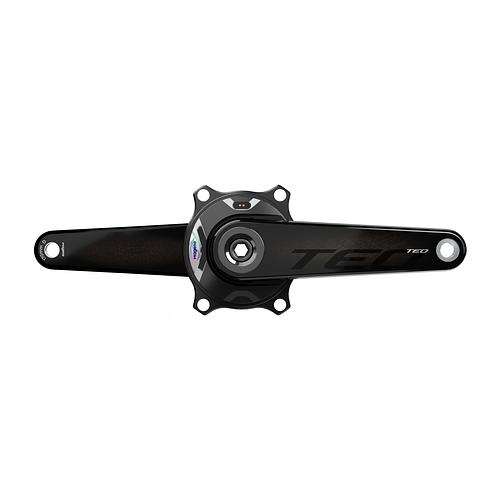

The Magene TEO/PES P515 power meter crankset offers impressive ±1% accuracy and long battery life, with a budget-friendly aluminum version and a lighter but pricier carbon version, though installation requires careful attention to bottom bracket compatibility.
Pros
- Accurate power measurement within ±1%
- Long 330-hour battery life
- Carbon option significantly lighter (425g total vs 625g aluminum)
- Compatible with Shimano 4-arm chainrings
Cons
- Installation requires specific bottom bracket (29mm Dub for carbon) and spacer selection
- Proprietary spider lock ring prevents swapping crank arms
- Carbon version costs significantly more (≈99,000 yen vs ≈43,560 yen for aluminum)
- Sprint max power can read up to 5% higher than pedal-based meters
Key Facts
- ±1% power accuracy, validated within 0.1W average difference in road testing
- 330-hour battery life with magnetic USB charging
- Carbon model weighs 425g total (spider 100g + crank arms 325g); aluminum model weighs 625g
Reviews & Ratings
![そのパワーメーターは信用に足るか?測定精度を徹底検証 [MAGENE TEO-P515]](/youtube-cycling-reviews/1292.png?1785919406)
The reviewer tests the Magene TEO P515 power meter crankset, the carbon crank version, against a Favero Assioma Duo power meter. He finds the power measurements to be very accurate, with average power differences under 1% in steady-state tests and in real-world riding. He praises the aluminum crank version for its cost-effectiveness and the carbon version for its low weight, but notes the carbon version is much more expensive and has proprietary parts. Overall, he concludes that the P515 is a reliable power meter for training, with the aluminum version being the best value.
AI Summary
Pros
- Accurate power measurement: within 1% of reference power meter in tests.
- Consistent average power across various power zones.
- Reliable for power training.
more pros in the video
Cons
- Carbon version costs ~99,000 yen, which is high, though cheaper than buying similar components separately.
- Spider arm lock ring is proprietary, so you cannot attach a different crankarm.
- During sprint max power, P515 can read slightly higher (up to 5%+) compared to pedal-based power meter.
more cons in the video
Key Points
- Model reviewed: Magene TEO P515 (carbon crank version) and also discussed PES P515 (aluminum).
- Two grades: PES P515 (aluminum) and TEO P515 (carbon).
- Power meter spider is same on both.
more key points in the video

The reviewer tests the Magene TEO P515 Power Meter Crankset, highlighting its carbon crank arms, accuracy, and weight savings compared to the aluminum version. He details the installation process, compatibility issues with bottom brackets, and validates its performance against a smart trainer.
AI Summary
Pros
- Uses carbon crank arms for significant weight reduction
- Very accurate with ±1% accuracy
- 330 hours of battery life
more pros in the video
Cons
- Requires swapping bottom bracket for 29mm spindle (SRAM Dub standard)
- Installation was not straightforward due to bottom bracket compatibility issues
- Uses a 10mm bolt requiring a specific torque wrench (reviewer suggests 8mm would be better)
more cons in the video
Key Points
- Retail price: $549 USD
- Uses 29mm aluminum spindle (SRAM Dub standard)
- Accuracy: ±1%
more key points in the video
Where to Buy
Magene TEO P515 Power Meter Crankset

Questions about Magene TEO P515 Power Meter Crankset
Sign up and share your experience — help other riders decide!
Create Account & Review