

After meeting the team at Eurobike 2025 and putting over 500 km on my new LCR18 build, I traveled to Xiamen, China, to visit the LightCarbon headquarters. I wanted to see exactly how these frames are engineered and what goes on behind the scenes in their factory.
See the full interview on my Youtube Channel:
The Origin of LightCarbon
Founded in 2012, LightCarbon originally operated under a Chinese name before moving to Xiamen in 2016 to establish the "Light Carbon" trademark and launch their international website. While they began with a focus on carbon frame sets—including forks, seat posts, and handlebars—they expanded in 2019 by investing in a rim factory and launching their dedicated wheel brand, Pro-X.
Designing the LCR18: Listening to their Customers
The development of the LCR18 was driven directly by customer feedback. While LightCarbon had several racing-oriented frames like the super-light LCR17, they noticed a significant gap in the market for high-performance endurance geometry.
The design process for a frame like the LCR18 typically spans about a year:
Research & Analysis: Studying existing endurance models to identify design advantages without simple duplication.
Prototyping: Moving from 2D drawings to 3D prints to check details in real life.
Testing: Building molds and producing samples for rigorous internal and customer testing before mass production.
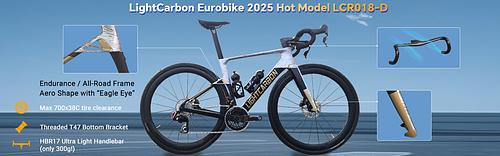
Innovation and Challenges: Down Tube Storage
One of the most requested features was down tube storage, a design common in high-end mountain bikes but challenging to implement in carbon road and gravel frames.
The team at LightCarbon highlighted that creating a functional storage system is not as simple as it looks; it requires significant "trial and error" to ensure the structure remains strong while avoiding rattling issues. Recent updates to the system include using softer materials to prevent noise and a revised locking mechanism to ensure the cover stays secure on rough gravel roads.
The Factory Floor
Walking through the factory in the Tong'an district, the attention to detail in the production process is evident:
Material Storage: They use genuine Toray carbon fiber, which is kept in cold storage at approximately 3°C to maintain its properties
Puzzling: One worker cuts the carbon sheets into tons of pieces that all have a specific place to be applied by the workers.
Manual Labor: Each frame requires roughly two hours of manual labor just to glue the carbon sheets according to a specific layer plan.
Molding: Every frame size requires its own unique mold, which can cost up to $20,000 each.
Curing: Frames are cured in an autoclave under defined pressure and temperature for several hours.
Quality vs. Price: The $500 - $1,000 "Sweet Spot"
A major part of our discussion focused on the price of carbon frames. LightCarbon aims to provide 70% to 90% of the quality of "big brand" frames at only 30% to 40% of the cost.
Gavin shared a warning regarding ultra-cheap frames:
Under $500: It is extremely difficult to maintain high quality at this price point. Some manufacturers may use fiberglass or unknown carbon fibers instead of Toray to cut costs.
The Sweet Spot: LightCarbon positions itself in the $500 to $1,000 range, which allows for proper QC, material costs, and rigorous testing
ISO Tests
One of the highlights of the tour was visiting the testing lab. LightCarbon tests their frames to ISO 4210 standards, often pushing them to 1.5x or 2x the required safety margins. During the visit, I saw several key tests in action:
Falling Mass Impact Test: A 22.5 kg striker is dropped onto the frame/fork assembly to simulate heavy impacts.
Stiffness Tests: We observed a lateral stiffness test applying 20 Newtons to the fork to measure sideways twist.
Horizontal Fatigue Test: In this test, the fork is replaced by a specialized machine that pulls the frame back and forth repeatedly to simulate the long-term stresses of road riding.
Interestingly, these tests were being conducted in the same room where a well-known World Tour brand was testing their latest models at the same time. This highlights that while the price point is different, the safety and engineering standards are often identical to what the professionals ride.
Future Projections: E-Bikes and the DJI Revolution
When asked about the next five years in the cycling industry, Gavin noted that traditional carbon frame development has largely hit a bottleneck. While details like down tube storage and micro-suspension can be refined to improve comfort and utility, he believes there is limited room for major structural innovation in standard road and gravel frames.
Instead, Gavin sees the most significant future growth and rapid innovation happening in the e-bike sector. Unlike traditional frames, electronic components can be upgraded much faster and more significantly. Specifically, he predicts that DJI Avinox motors will become increasingly popular, citing very positive feedback from early reviews and testers. As a result, the industry will see a shift toward more carbon frames specifically engineered to integrate the DJI system, a plan that they also persue for 2026.
Final Thoughts
The engineering and strict QC protocols I witnessed firsthand have certainly added a layer of confidence to my own LCR18 build. However, my overall impression of LightCarbon is that they aren't trying to be the next big "End Consumer" brand in the way Western riders might expect.
Interestingly, while the LCR18 has become their best seller since Eurobike 2025, they haven't officially listed it on their main website yet. Gavin explained that this is a conscious choice due to current production capacity; they already have a significant backlog and don't want to over-promise on delivery times until they have more stock ready in 2026.
While some Western critics might find the "LightCarbon" name a bit generic or the lack of a "Buy It Now" button frustrating, these seem to be intentional choices. They appear to be positioning themselves primarily as an OEM partner looking for larger, long-term business-to-business orders. From my perspective, their willingness to sell to individuals feels less like a push for markt share and more like a strategic "advertisement" to prove their quality and reliability to the wider industry. In the current volatile industry climate, they seem content to grow carefully and slowly, focusing on being a stable, long-term supplier rather than chasing rapid consumer expansion.
While I was there, I got a sneak peek at a brand-new Aero Gravel Racing Frame. This is currently an early prototype and will be shown at Eurobike. The design is still subject to change, but it can be seen in the video.