

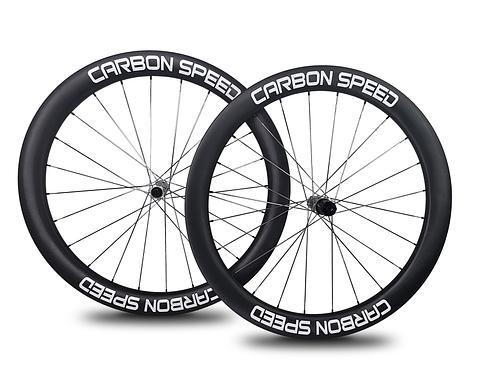

Estos juegos de ruedas de carbono para gravel son muy apreciados por su construcción ligera, excelente calidad de construcción, conducción suave con buena aceleración y buena relación calidad-precio, aunque presentan una sensibilidad notable al viento cruzado y un ruido de frenos más fuerte.
Pros
- Excelente calidad de construcción con acabado interno impecable y estética de alta gama
- Muy ligeras para ruedas de gravel anchas
- Conducción suave con buena aceleración, mantenimiento eficiente de la velocidad y amortiguación de vibraciones de los radios de titanio
- Configuración sin cámara fácil con excelente retención de aire
Contras
- Sensibilidad notable al viento cruzado debido a llantas altas y ligeras con neumáticos de alto volumen
- Ruido de frenos más fuerte ya que las ruedas actúan como cámaras de resonancia
- Requiere un ajuste cuidadoso de la presión de los neumáticos debido al ancho interno amplio de la llanta
- Los radios de titanio pueden ser más difíciles de conseguir para reparaciones en comparación con radios estándar
Datos clave
- 53 mm de profundidad de llanta, 33 mm de ancho interno, 42 mm de ancho externo
- Construcción de carbono T1100 (también disponible versión T800)
- Peso: 1330-1445 g según la configuración
Reseñas y valoraciones
Los juegos de ruedas de gravel de carbono Carbon Speed T1100 con radios de titanio son ruedas de alto rendimiento elogiadas por su construcción ligera (1330-1445 g dependiendo de la configuración), excelente calidad de construcción y características de conducción suave. Los atributos clave incluyen 53 mm de profundidad de llanta, 33 mm de ancho interno/42 mm de ancho externo, construcción de carbono T1100, radios de titanio o Sapim CX-Ray, y bujes internos con sistema de trinquete de 36 dientes. Los precios oscilan entre 715-900 USD dependiendo del grado de carbono y el material de los radios, más envío. Los usuarios informan configuración sin cámara fácil, buena aceleración y amortiguación de vibraciones de los radios de titanio, aunque algunos notan sensibilidad al viento cruzado y ruido de frenos más fuerte.
Resumen IA
Pros
- Excelente calidad de construcción con acabado interno impecable y estética de alta gama
- Muy ligeras (1330-1445 g dependiendo de la configuración) para ruedas de gravel anchas
- Conducción suave con buena aceleración, mantenimiento eficiente de velocidad y amortiguación de vibraciones de los radios de titanio
- Configuración sin cámara fácil con excelente retención de aire
- Bujes de alta calidad con rodamientos suaves y acoplamiento de buje libre impecable
- Buena relación calidad-precio en comparación con marcas premium
Contras
- Sensibilidad notable al viento cruzado debido a llantas altas y ligeras con neumáticos de alto volumen
- Ruido de frenos más fuerte ya que las ruedas actúan como cámaras de resonancia
- Requiere ajuste cuidadoso de la presión de los neumáticos debido al ancho interno amplio de la llanta
- Los radios de titanio pueden ser más difíciles de conseguir para reparaciones en comparación con radios estándar
Hi all, After a bit of a delay, I’m finally sharing my first impressions of a prototype gravel wheelset from XM Carbonspeed. I had a chance to chat with Peter from XMCS at Eurobike and received the wheels at a discounted rate in exchange for providing honest feedback here. Unboxing & Initial Impressions • Finish: Matte satin surface, golden water-transfer logos, raw titanium spokes, black hubs and nipples – very clean, high-end look. • Rim profile: 42 mm outer / 33 mm inner width. Looks massive at first glance, but pairs surprisingly well with 40–45 mm tires and creates a smooth aero transition. • Build quality: Excellent. The internal finish is flawless – no carbon debris, resin residue or visible imperfections. Measured Weight (kitchen scale) • Front: 615 g • Rear (HG freehub): 720 g • Total: 1,335 g The XDR version is ~3 g lighter. Very impressive numbers for such wide rims with titanium spokes. XMCS claims T1100 carbon – which could explain the low weight, assuming durability holds up. Tubeless Setup • Tape: Buckless 35 mm • Valves: Buckless aluminum • Sealant: Schwalbe Doc Blue (60 ml front / 65 ml rear) • Tires: Tufo Gravel Thundero – front 40 mm, rear 44 mm (both used) Setup was straightforward – both tires seated immediately with a Tyre Booster. Measured Tire Widths (@32 psi, compared to Zipp 303s) • Front: 39.6 mm → 43.6 mm • Rear: 43.3 mm → 47.6 mm Next Steps I’ll be testing them further on my custom titanium gravel bike – visually a perfect match. Ride impressions to follow soon. If you have any questions or want specific feedback, feel free to ask!
Hi all, I’ve completed my first rides on the wheels – about 200 km in total. Unfortunately, my last outing ended in a self-inflicted crash, so here’s just a quick update before I post a full review once I’m back on the bike. Roughly half of the distance was on tarmac, the other half on light gravel (what we’d call “forest Autobahn” in Germany), with only a few short singletrack sections. So far, no major climbs or descents and no technically challenging trails – that part is still to come. pros • The wheels accelerate well and hold speed efficiently • Hubs and bearings run extremely smooth • Freehub engagement is flawless so far • Tubeless setup was easy and air retention has been excellent • Possibly due to the titanium spokes, there seems to be better damping of small vibrations from the surface • Aesthetics are great – they look as good as they ride neutral / learnings • Due to the wide internal rim width, tire pressure can and should be set significantly lower compared to my previous 23 mm internal rims • The wheels act as a large resonance chamber and brake noises can be noticeably louder cons • With the tall, lightweight rims combined with high-volume tires, cross-wind sensitivity is noticeable • They tempt you to ride faster than you probably should
Did my first ride today (~72km) and I'm really happy with the result. It's comfortable, has lots of grip and is feels quick. But I don't have any data to back that up. I simply believe the latest research which shows that... • wider tires reduce rolling resistance • increasing comfort through greater air volume as suspension minimizes rider fatigue And all of that without compromising performance. The widths match quite nice according the 105%-rule (42mm outer rim width; 39.5mm tire width). The Michelin Pro 5 tires have an unmounted tread width of 45mm, which is even more than the Pirelli P Zero 40-622 at 42mm. This means that even when stretched, the risk of running off the tread is reduced. Regarding ETRTO compliance: I don't really like the concept of regulatory documents being behind a paywall. Additionally, it seems that bicycle tire standards are outdated and not up to current requirements. The complexity also exceeds that of car/motorcycle tire standards. While ETRTO is indeed a technical institution with regulatory purposes and its importance is highly regarded in various forums, threads, and Reddit discussions, this apparently doesn't tell the whole story. This article provides valuable insights: The most prominent example of deviating from ETRTO standards is SRAM/Zipp. They allow a 40mm tire on their 303 XPLR wheels (32mm inner width rim) through their 'dual testing' approach, far from ETRTO standards.
Dónde comprar
Carbon Speed T1100 carbon 700C 53mm depth 32.5mm internal 41mm external width gravel wheelsets with titanium spokes
Preguntas sobre Carbon Speed T1100 carbon 700C 53mm depth 32.5mm internal 41mm external width gravel wheelsets with titanium spokes
Sign up and share your experience — help other riders decide!
Create Account & Review