



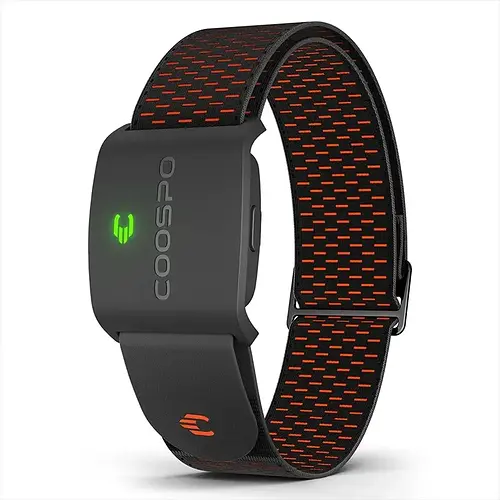
I know Coospo from their HW9 armband heart rate monitor. I'm on my second one (I lost the first), and it has never given me trouble. So when I met them at Eurobike and they offered me their S10 power meter, I wanted to know whether that carries over to power.
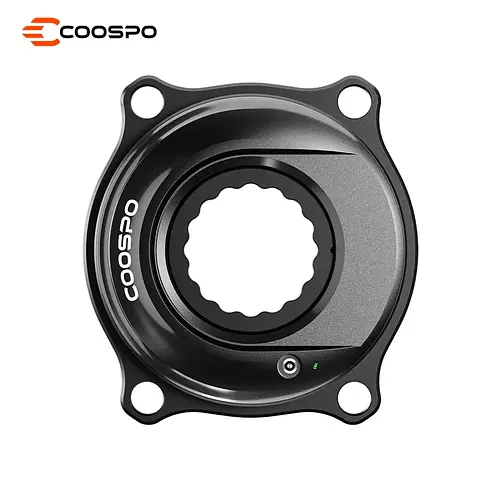
The S10 is a spider power meter for Easton CINCH cranks. Coospo also sells it as a set with a carbon crankset and titanium spindle, which is the version I tested. I measured it against my Favero Assioma Duo over several weeks, about 8 hours of dual recordings, with two different units.
A caveat up front: Coospo sent me the crankset and later a replacement unit. They did not see the video or this post before publishing. I have a discount code (MYBIKEPARTS, 10 %) that earns me a small commission.
Video (German): https://www.youtube.com/watch?v=yU4MH1A4nwM
What you get
The S10 sits between crank and chainrings. It measures with strain gauges in the spider, so it sees both legs together. The left/right balance in the app is calculated, not measured. It does not need to know your crank length.
Table is sortable
Coospo S10 |
|
|---|---|
Interface |
Easton CINCH, chainrings 110 BCD 4-bolt |
Spindle |
24 mm or 29 mm |
Claimed accuracy |
±1 % |
Range |
0 to 2800 W, 20 to 240 rpm |
Battery |
300 h, magnetic charger |
Radio |
ANT+ and Bluetooth |
Crank lengths |
160, 165, 170, 172.5 mm |
Weighed on my scale, 165 mm:
Table is sortable
Weight |
|
|---|---|
C12 carbon arms + Ti spindle |
352 g |
with S10 spider |
453 g |
RIRO carbon chainrings 50/34 |
157 g |

Prices
Prices checked at checkout in October 2026, shipping to Germany, including import charges. Since the summer, VAT is already in the AliExpress listing price and duties plus a handling fee come on top at checkout, so older prices you may remember are about 20 % lower.
Table is sortable
Item |
Where |
Price |
|---|---|---|
Coospo C12 carbon set |
Coospo website, code MYBIKEPARTS |
408.65 € |
Coospo C12 carbon set |
AliExpress |
423.68 € |
S10 spider only |
AliExpress |
118.36 € |
If you are not in a hurry, 11.11. and Black Friday are usually cheaper.
Installation
The Easton CINCH system needs only an Allen key for the spindle. For the spider lockring you need a cassette lockring tool (e.g. Shimano TL-LR10), and a torque wrench is a good idea.
On my frame (LightCarbon LCR018-D, T47 85.5 mm inner, Rotor bottom bracket) the manual said no spacers are needed. With no spacers the crank had several millimetres of play, no matter how hard I tightened it. After I sent photos, Coospo's technicians recommended 3 mm of spacers on each side (2 + 1 mm). That is how I ride it now.


What I miss on the product page is the Q-factor and the spindle length. With those I could have checked this before ordering.
There are two apps. CoospoRide is for riding and devices, CoospoTools is for firmware updates and calibration. I first looked for the update in the wrong one. CoospoTools also lets you correct the power output from 90 to 110 % in whole steps.

How I measured
Reference: Favero Assioma Duo pedals, bought used
Every ride recorded twice, one head unit per power meter (Wahoo ELEMNT BOLT, COROS PACE 3), sometimes an iGPSport i630 in the jersey pocket as a control on the S10
Only seconds where both meters record pedalling (above 50 W and 50 rpm) count for the main number. Otherwise coasting gets mixed in, and two head units record coasting differently
To check the reference itself, I ran the same Assioma against a GeoID PM500 spider: three rides, all within 1.5 %
All rides are on our comparison tool, which aligns the two files by cadence and shows the result second by second: https://mybike.parts/powermeter/comparisons
Unit A: a factory calibration fault
The first unit read +6 to +12 % high in three rides. It was not a percentage error but a fixed offset of about +16 W, no matter how hard I pedalled. Zeroing it mid-ride moved the zero point by 13 W.
I sent Coospo the raw files. They first pointed at the Easton interface, then, after looking at the data, wrote that their development team sees a problem with the factory calibration. They sent a new spider and asked me to return the old one for analysis, which I did.
Everything below is the second unit, on the same crank and the same Easton interface.
Unit B: about 3 % low
Table is sortable
Ride |
Duration |
Pedalling only |
|---|---|---|
19.09. |
2 h 20 |
−2.0 % |
22.09. |
42 min |
−3.5 % |
26.09. |
2 h 37 |
−3.1 % |
The error scales with power rather than adding a fixed amount, and it does not drift. Over the 2 h 37 ride without any zeroing, the first and last quarter were both between −2.4 and −3.8 %, across more than 10 °C of temperature change. Zeroing mid-ride changed nothing.

What you see after a ride in Strava is 1 to 4 % lower than the Assioma in all three rides, dropouts included. At 200 W that is 3 to 7 W.

Full comparison of this ride: https://mybike.parts/pm/6BDhNioYEyyaXqp2xHrX_w
Power curve and sprints
Peak values over 1 and 5 seconds come out up to 5 % higher on the S10, because it jumps to the peak faster while the Assioma ramps up over three or four seconds. From 30 seconds on it is back to the usual 1 to 4 % below. I would not use it for second-by-second sprint analysis.

Residual torque
A known criticism of the S10 (and the ThinkRider PP5) is residual torque: after a hard effort part of the load stays in the zero point and the meter reads high until you zero it again. It was reported on firmware 1.7.2.
I checked every sprint above 450 W, comparing the minutes before with the two minutes after. On unit B I found none: 16 sprints, and the average change afterwards was practically zero (+0.37, −0.02, −0.13 Nm per ride). My sprints were short, 5 to 10 seconds. I have not tested long efforts on a climb, which is where it was reported.

Full comparison of this ride, with a second head unit as control: https://mybike.parts/pm/vRiCMP-2nlW82K3I-z9kHA
Dropouts
Now and then the S10 shows 0 W for one to four seconds while I am pedalling. A second head unit on the same S10, one on Bluetooth and one on ANT+, goes blind in the same seconds, so it is the sensor and not the radio.
It happens almost only when cadence changes:
Table is sortable
Ride |
Steady cadence |
Changing cadence |
|---|---|---|
19.09. |
0.05 % |
10.4 % |
22.09. |
0.00 % |
9.4 % |
26.09. |
0.20 % |
12.3 % |
The GeoID PM500 had similar dropouts on my Wahoo, so this is not only a Coospo issue.
Head units do not agree either
One thing I did not expect: two head units receiving the same ANT+ data from the same power meter still end up with different averages. The Wahoo writes a hard 0 when a packet is missing, the iGPSport repeats the last value. On the 22.09. ride the S10 read −3.5 % on the COROS (Bluetooth) and −4.5 % on the iGPSport (ANT+).

So part of what people report as power meter accuracy is the head unit. I want to look into this more, ideally by logging the raw ANT+ packets.
What Coospo plans for 2027
This is what Coospo told me and allowed me to share. I have not tested any of it.
Table is sortable
Model |
What it is |
|---|---|
S11 |
Same as the S10 with a different look, for the Chinese market. Not a successor |
S20 |
The successor: a spider for SRAM 8-bolt cranks instead of Easton CINCH, still with 110 BCD chainrings. Coospo says it is much more accurate, as they see the Easton interface as the weak point |
P10K / P10S |
Power meter pedals for Look Keo and Shimano SPD-SL |


Coospo wants to sell these through dealers first, so problems can be handled locally instead of by mail to China. After my first unit, I understand why.
Conclusion
It does not reach the claimed ±1 %. The good unit is about 3 % low, and the first one was faulty, which you will not notice without a second power meter.
A good unit has a stable zero, no drift, no residual torque in my rides, and averages within 1 to 4 %. For riders who look at averages and trends and train against themselves, that is enough. If you have a reference, you can correct the 3 % in CoospoTools.
Carbon set: a light carbon crank with titanium spindle in the same weight class as Red E1 or Cybrei, with a power meter included. Double-check whether you need spacers.
Spider only: if you already ride an Easton CINCH crank and are fine with averages.
If you want to compare numbers with other riders or between bikes: get a used Assioma Duo. They come up often on classifieds (Kleinanzeigen in Germany), around 300 €.
If accuracy matters most at a low price: the GeoID PM500 was within half a percent on my bike, but it only comes as a complete Shimano 24 mm crankset in aluminium. My test: https://www.youtube.com/watch?v=X0tL-2ndoVQ
One tip for any power meter: zero it once when it is warm, after about twenty minutes, standing still. On the faulty unit that moved 13 W, on the good one nothing. You do not know in advance which kind you have.
Links

Compare your own two power meters: https://mybike.parts/powermeter/comparisons
Similar like Compare-The-Watts on this site, but persistence, match by cadence, different average values and multi/three-way-comparisons.