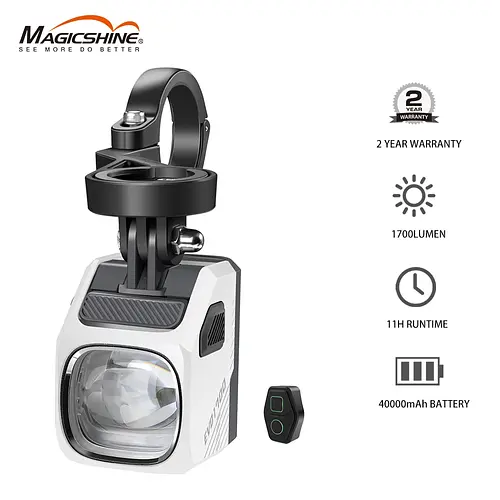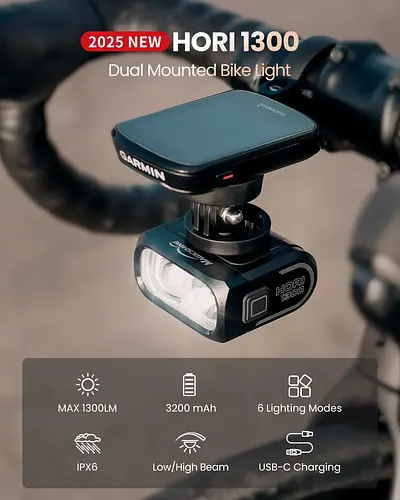


When it comes to a bike light, I care about brightness and runtime, but also about a mount underneath the bar, since it keeps the cockpit clean. Beyond that I want a high beam, a remote and a sharp cut-off, so that I don't blind anyone. The Gaciron CETUS-1700 offers all of that for around 56€ 59 €, which is why I wanted to take a closer look.
Gaciron is a smaller player in the light business. I stopped by their stand at Eurobike in 2025 and 2026, and in 2026 I asked them whether they could send me one of their new lights.
Please note: Gaciron sent me the light for free. They did not pay me for the review and did not see the video or this post before publishing. I have a discount code (MYBIKEPARTS, 10 %) that earns me a small commission.
I compared it with the two lights from my last light video, the Magicshine EVO 1700 Pro and HORI 1300 Pro. I measured the cut-off and the runtime myself with a lux meter (UNI-T UT383BT).
Video (German): https://www.youtube.com/watch?v=vab-BRXD8E8
What you get
Table is sortable
Gaciron CETUS-1700 |
|
|---|---|
Max. output |
1700 lm |
Battery |
16.17 Wh, sold as "4200 mAh" |
Charging |
USB-C, 5 V / 2 A, about 2 h |
Waterproofing |
IPX6 |
Size |
47.6 x 52.5 x 71 mm |
Weight |
181 g, out-front mount about 60 g |
Material |
Aluminium and nylon |
Colours |
Black, white, pink |
Connectivity |
Wireless remote only. No Bluetooth, ANT+, FTR or app |
The box contains the light, an out-front mount for round bars (25.8 / 31.8 mm, Garmin interface), a GoPro adapter, the remote with a rubber strap, a USB-C cable and some small parts.

Cetus is Latin for whale, and there are a few whale symbols on the back. The name fits, because it is chunkier than similar lights. Whether you like that is up to you. The white one on my bike looks fine to me.
Mounting
The round bar mount is no use on my aero handlebar, but the GoPro adapter attaches directly to the mount I already have. The light slides into a rail until it clicks, and a small plastic nose releases it. There is no magnet, but you can take the light off without undoing the GoPro bolt.
On my LightCarbon I have the same problem as with other lights: there is not much space under the cockpit, and the light hits the head tube before it tilts down far enough. I added a second GoPro joint, and with that it works. If you have an integrated cockpit, check the tilt angle before you buy.
A comment under my last light video said that some cheap lights flicker or switch off on cobblestones and gravel, probably because of a loose battery contact. I tried that here and noticed no interruption.
Modes and controls
A short press moves through the first four steps. 1700 lm is only reachable by double click, and the two flash-type modes are hidden:
Table is sortable
Step |
Beam |
Claimed runtime |
|---|---|---|
300 lm |
Low beam |
about 6 h |
600 lm |
Low beam |
about 3.5 h |
450 lm |
High + low beam |
about 4.5 h |
900 lm |
High + low beam |
about 3 h |
1700 lm (double click only) |
High + low beam |
about 2 h |
Breathing, 50 to 100 lm (hidden) |
about 20 h |
|
Daytime flash, 600 lm (hidden) |
about 24 h |
Claimed runtimes are from the manual. I measured two of them, see below.
The cycle is my main complaint. Say you are on 600 lm and a cyclist comes towards you. To get down to 300 lm you have to press three times, and twice of those you pass through high beam. That is exactly the moment you don't want it. I prefer high and low beam on separate buttons.
There is a workaround, and it is how I would ride it: stay on 300 lm, double click for 1700 lm, single click to return to 300 lm. The single click returns to the saved mode, so this also works from 600 lm. You only have to learn it once.
Things I noticed:
Every click beeps, and you can't turn it off. It gets a bit annoying. A long beep marks 1700 lm, so you can hear it without looking.
There is no flash mode in the normal cycle.
The 450 lm high beam step is darker than the 600 lm low beam, and I find it rather pointless.
The remote has one button and does what the button on the light does, with one exception: it did not switch the light on from off when the light is in the always-on mode it seems. I had to shake the light first.
Button combinations
Table is sortable
Action |
Result |
|---|---|
Off, press 0.75 s |
On |
Off, short press |
Battery level: blue 100 to 61 %, yellow 60 to 21 %, flashing red 20 to 1 % |
Off, hold 5 s |
Transport lock |
Locked, 5 clicks within 3 s |
Unlock. It ships locked, so try this first if it does not switch on |
On, hold 2 s |
Hidden modes, breathing and daytime flash, and back |
In daytime flash, hold 5 s |
Toggles the motion sensor, confirmed by 3 flashes |
By default the light goes to standby after 2 minutes without movement and wakes up when it moves. I switched that off for the runtime test.
Cut-off and stray light
I saw at Eurobike that the cut-off looks good, and this time I wanted a number for it. I put the lux meter in front of the beam and measured 5, 10 and 20 cm above the cut-off, with a ruler, for the two lowest low beam steps of all three lights.

Table is sortable
Lux above the cut-off |
+5 cm |
+10 cm |
+20 cm |
|---|---|---|---|
HORI 1300 Pro, 200 lm |
84 |
48 |
35 |
CETUS-1700, 300 lm |
270 |
230 |
90 |
EVO 1700 Pro, 200 lm |
500 |
300 |
100 |
HORI 1300 Pro, 400 lm |
187 |
100 |
56 |
CETUS-1700, 600 lm |
560 |
500 |
180 |
EVO 1700 Pro, 400 lm |
1200 |
720 |
260 |
Lower is better. The absolute value is what matters here, because that is what reaches the eyes of oncoming traffic. Note that the CETUS steps have more lumens than the steps they are compared with.
The order is the same as what I would have said by eye: the HORI has by far the cleanest cut-off, then the CETUS, then the EVO. The cut-off works, but some light still scatters upwards. With a correct setup you will blind oncoming traffic hardly or not at all. To be on the safe side I would leave it on 300 lm when someone is coming.
This was a simple measurement with one unit of each and a ruler, so take the numbers as a comparison, not as lab values. You can see the beam at all steps and next to the EVO in the video from 5:43.
For my next light review I want to do more lux measurements, and I will also give you the distance to the light and comparison values, so the numbers are easier to place.
Charging and runtime
USB-C with 2A charges quickly enough, in about 2 hours according to Gaciron. The port is on the underside, under a rubber plug, which is unusual. If you want to charge while riding, a normal cable makes an ugly loop. An L-shaped cable is neater. On the other hand, it might be better for water protection, as less rain might get in through that port.
I measured the runtime in a dark closet, standing still without a fan, with the lux meter standing in the hotspot. With airflow from riding it may look different, which I did not test.


Table is sortable
Mode |
Runtime measured |
Claimed |
Note |
|---|---|---|---|
1700 lm |
1:51 h, then 23 min emergency pulse |
about 2 h |
32 % after 2 min, 20 % at the end |
600 lm |
3:23 h, then 34 min emergency pulse |
about 3.5 h |
69 % after 15 min, 51 % at the end |
300 lm while charging |
Over 4 h, then I stopped |
97 % after 4 h |
1700 lm. No light of this kind can hold the number on the box. The LEDs produce heat, and it has to go somewhere, so the light regulates itself down. Here it is at a third after only 2 minutes and declines slowly from there. So "2 hours at 1700 lm" is true as the time until it gives up, not as 2 hours of 1700 lm. A 16 Wh battery could not do that anyway. It also gets very hot on the bench. I did not measure the temperature.
600 lm. This is the mode I would actually use. It drops to about 70 % in the first 15 minutes and then declines evenly, without a sudden step to a fraction of the output. The time matches the claim. I find 600 lm enough for most riding.
Emergency mode. Below 10 % battery the light starts pulsing by itself. That leaves you 20 to 30 minutes to get somewhere.
Charging while riding. This works, but the light always falls to 300 lm, whatever you had on. It ran for over 4 hours from a power bank with almost no change. So you can ride through the night with a power bank, just not with much light. Only 10 W go in over USB, so more would not be possible anyway.
The battery
The box says 4200 mAh. I opened it: small T3 Torx screws on the back, and inside is a blue pack with a plug instead of soldered wires.

The print says 3S, 11.55 V, 1400 mAh, 16.17 Wh. So these are three cells in series. 4200 mAh is the three added up, and the useful number is 16 Wh.
The EU Battery Regulation (2023/1542) requires from 18 February 2027 that new devices have a battery you can replace yourself with normal tools. The CETUS is already built that way. I asked my contact at Gaciron, who said it complies and that they will sell this battery in the future. So far that is only what they told me.
If you do replace it, don't use a standard 11.1 V hobby LiPo. 11.55 V means high-voltage cells, and a normal pack would be overcharged.
Road legal in Germany?
For German readers: it has no K number, so it is not approved for road use in Germany. Gaciron is a small manufacturer from Shenzhen selling worldwide, so I don't expect a version just for Germany any time in the near future. In my opinion, the cut-off and quality of the light would probably not be the problem. The hidden flash mode and the missing blue high beam indicator rule it out from the start.
Outside Germany this does not matter. On holiday in Austria, Switzerland, Poland or Czechia it is no problem. Germany does have a very peculiar way with this kind of ancient red-taped light registration (that does not apply to helmet lights for instance).
Thus, I can't recommend to use it in German traffic, but I would state the fact that it is still obtainable by Gaciron's online shop and I never heard about a police control that gave out a fine for having a non-glaring unregistered light.
Whatever light you ride, PLEASE check the setup regularly. Ride up to a glass shop front and see if you dazzle yourself.
Compared with the Magicshine EVO 1700 Pro
The two look similar and have nearly the same specs on paper, so this is the obvious comparison.
Table is sortable
CETUS-1700 |
EVO 1700 Pro |
|
|---|---|---|
Price |
65.91 € |
93.95 € |
With code |
about 59 € |
79.86 € |
Lowest step |
300 lm, about 6 h |
200 lm, 14 h * |
1700 lm |
about 2 h |
2:30 h * |
Battery |
16.2 Wh |
about 16 Wh (4400 mAh) |
Charging |
about 2 h |
about 3 h |
Weight |
181 g |
165 g |
Mount |
Rail, out-front mount included |
Magnetic, out-front mount included |
Bluetooth, app |
No |
Yes |
Stray light, +5 cm, lowest step |
270 lux at <1m |
500 lux at <1m |
Manufacturer figures. fahrradbeleuchtung-info.de measured the EVO 1700 without Pro and found that it reaches its long runtime by dimming over time. I did not measure the EVO's runtime myself.
The EVO's 79.86 € is with the a generic affiliate code, not mine. EVO prices are from October 2026.
The extra size of the CETUS does not bring a bigger battery. I think part of it is that the battery is replaceable, which needs space. On the EVO I did not see a way to open it.
Price
I checked the prices at gaciron-shop.com in October 2026, with shipping to Germany and tax included.
Table is sortable
Price |
|
|---|---|
Regular |
65.91 € |
With code MYBIKEPARTS (10 %) |
about 59 € |
Halloween flash sale, ended 31 Oct. |
56.34 € |
In the video I say 56 € with the code. That was the sale price, and the code gets you to about 59 €. The code could not be combined with the sale.
For Germany, get it from the Gaciron shop, as the AliExpress and Amazon sellers don't ship it here. Elsewhere you may find it there too, possibly cheaper with the right coupons.
Conclusion
Overall it is a good light for the money, and a clear step forward compared with Gaciron's older lights. I don't know a cheaper light that has an under-bar mount, a high beam, a sharp cut-off and a remote. If you know one, tell me, I would like to test it next.
What I would hold against it:
One button: to step down you have to go through the high beam. The double click workaround helps.
The remote can't switch it on.
Chunkier and heavier than the EVO.
Beeps on every click, and the USB port is on the underside. I can live with both.
No Bluetooth, ANT+ or app.
My recommendations:
CETUS-1700: if you want this type of light and don't want to pay more.
EVO 1700 Pro: if you want the magnetic mount, an app, and a remote that switches it on, or like a more compact variant
HORI 1300 Pro: if the cleanest cut-off matters most to you and the minimalistic design
CETUS-MAX: if you need more battery. Same design, 2000 lm, 5400 mAh, 212 g, about 3 h charging. I have not tested it.
Links